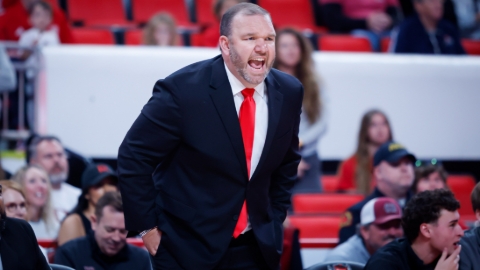
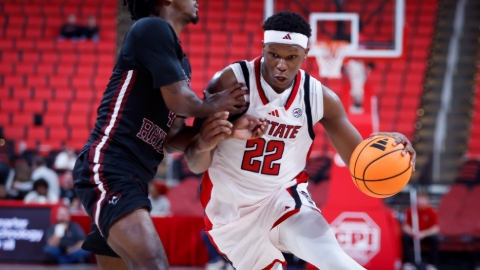
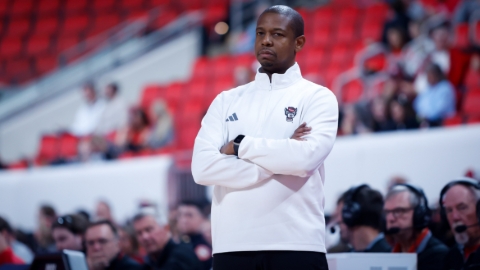
NC State head coach Justin Gainey met with the media to discuss his coaching staff, the retention of Paul McNeil Jr., and more!
NOTE: Click the video above to watch the full press conference!
So, Justin, I'll start with the obvious. How big was it to get Paul McNeil back for this season?
Oh, it was big. It was a big deal. We're excited to have him back, and I'm excited to be a part of his continued growth and development. I think, as you look at his career, his trajectory is just going up. I'm excited to be able to work with him and to help him as he tries to become who he wants to become as a basketball player, as a young man. Obviously, we all know what he does at a high level, right? And what he does, he does it as well as or better than anybody's ever done it here before. So it's just continuing to add to what he does while also moving that part.
How much of the roster building was centered around having a player like Paul in it for this upcoming season when you were constructing the roster, not knowing his decision?
As I looked at building a roster, my staff and I put a priority on shooting, as you can see. I think we did a good job addressing that across the board. Paul fits into that perfectly. It ended up working out pretty well when we think about what our goal was when we got into it, and then how we finished up with that. Obviously, his size and positional size are really attractive as well. He can play multiple guard positions. That made him valuable. We were looking at just across the board, just having good size and having shooting. So Paul fit in nicely.
When you guys were putting the staff together, was there a focus or a trait that you were trying to identify with each of those guys in terms of your assistants?
There were three things I was looking for. First, I was looking for guys of high character, guys that I could trust when they were out on the road representing NC State, guys that I'd be comfortable with going into parents' homes and them being able to communicate and being role models for these guys. I was looking for experience, guys that have done it before, that have been at this level and have been in those big games and know what it feels like being in those big recruiting battles and know what it feels like to get it done. And then the last thing was winning.
I wanted guys who had been a part of winning because it's hard. To win is really, really hard. A lot of people think that just winning a game happens on the day of the game or during that game. But so much goes into it beforehand, and guys that have won, they know what it feels like, they know what it smells like, know what it sounds like in the gym every single day. Those were the three characteristics I was looking at when I put the staff together, and I feel really good about the group and being able to pull those characteristics out.
Is it interesting that you were able to coach against two of them in the SEC? And then what also led to the thinking of retaining Patrick Stacy in his role?
Coach Goins is from Greensboro. We've got a lot of mutual people in common. As I thought about what I want my staff to look like from an offensive standpoint, I started thinking about who some of the tougher teams to guard that I'd played against were. Georgia was one of those teams. I liked how they played. I liked the spacing.
I liked the pace they played at. There were a lot of things that I liked about it, and I'd always put in the back of my head that when I become a head coach offensively from a philosophical standpoint, I want it to look like that. He and I started to build throughout the seasons, talk, and share ideas. When this opportunity happened, I didn't know if I'd be able to get him or not, but he was a guy I wanted to talk to. We had a few conversations, and it went well. Obviously, he came over, and I was so excited to have him.
And then with Coach Brooks, he's a vet. Everybody you talk to has nothing but praise for him. I've been in some recruiting battles with him, and he has a way about him of developing those deep relationships with kids and their families that have made him elite at recruiting. He's also a great defensive mind. Coming from Baylor, where they did a few different things, but a particular zone that they ran was really effective during that championship run, and that's something that we want to look to implement into what we do.
Having familiarity with both of those guys in the league, not only what they were doing there, but just getting to watch them in warm-ups, watch them as they walk through the halls, and have conversations with them. Both of those guys were guys that I was really impressed with and tucked away in the back of my mind as guys I'd love to work with.
Patrick Stacy?
I didn't know Patrick at all. He had worked with Amorrow Morgan, who was on my staff at Tennessee, and he raved about him, but I didn't know him. When I got here, April 1st was the press conference. Portal opens on the 7th. It was myself, Riley Collins, who was my player development guy, I brought with me from Tennessee, and Patrick was here. It was like, okay, we got to get to work.
I was impressed with how hard he worked, how prepared he was to be able to shift gears, and understood my vision as we entered the portal. We spent a lot of late nights together, a lot of late-night phone calls, and he made himself always available. Through that process, he was very impressive, and I started to warm up more to the idea of him being on our staff. As I started bringing other guys in and other assistants in, and they were able to spend time with him, they validated what I was seeing and what I was feeling. That made that decision really easy, to be honest, because I think he's a rising star in this business.
Once all the cameras shut off, once all the media went away, it was just you coming back home. What was the first thing you kind of did to realize you were back here at NC State?
So much happened that day. It was like a whirlwind. I had my whole family from all over. They came. They were here. All the former players that were there, some of them I hadn't seen in a while. It was so good to see them and be able to spend some time with them. After all of that happened and we got to the hotel, and it was just my wife and I, and my little guy had finally gone to bed, it was just something where we just kind of sat there and reflected on the entire journey that we had been through. I'm sure all coaches have that journey.
I told her I wouldn't be here without her because of her willingness to be by my side, her willingness to just pick up and move. I mean, I went from Elon to App State to Marquette in the Midwest to Santa Clara in California to Arizona, back to Marquette, and then to Tennessee. We bounced around. My oldest son went to three different high schools. Never once did she say, no, we're not moving. No, we can't do it. She always had my back. That was the exhale moment. That was when the dust had settled. I got to thank her, because without her, it wouldn't have happened.
Can you talk about analytics a little bit? How does that fit into your program? And what do you plan to do with that?
When I played, it's funny looking back on it, you had the three-point line that was at the top of the key. I can still remember my coach yelling that if you're going to shoot a three, your foot has to be right on the line. If you're running flex offense, you have eight guys inside the three.
The mid-range shot was something everybody tried to get to. As a former player of that era, it takes time to adjust to the analytics parts of it, and the understanding of the mid-range, maybe not being a great shot. I got a game-winner off of a mid-range shot against Maryland here in the arena. I stopped at the free-throw line and made one. It's hard to tell me the mid-range is a bad shot.
But those guys hit me with enough numbers through the years to be able to implement analytics into my processes, both offensively and defensively. Through the last few years, I'd say I've become even more aware of them and studied them more. Being on the defense side of the ball in the SEC, there are a lot of teams that play off of analytics.
So you've got to be prepared to stop them, and what makes that good, what makes it not good. I plan on implementing analytical views and concepts into everything we do. It's everywhere, from analytics to AI. You've got to figure out ways to make yourself more efficient, because that's the end goal: to become as efficient as you possibly can. We will do it. I've got a great staff of guys who understand it way better than I do and are even better at explaining it to me and allowing us to implement it into our philosophies.
What would your team look like on the floor, fast-paced, defensive-minded? What would your team look like?
I've got a vision of what I want it to look like, but what I'll say is we will play to our personnel. In this era, you're bringing all these guys in, and you think you know what they're going to look like, how they're going to play, but you never really know until you get them. I want to be clear that we're going to play to our personnel. We'll get a better feel for guys' tendencies and strengths and weaknesses to a greater detail. I think we know now with all the analytics and all the film we study, but as we get the group together, we'll get to see how that meshes together.
Philosophically, I want to play fast. I want to play with pace. I want to space the floor. Defensively, I want to be aggressive. I want to impose our will. Don't sit back and wait to be attacked. We'll mix up different defenses, primarily man-to-man, but we'll play a little zone. We'll get into some pressure and some zone pressure just to give different looks. A lot of that will be determined by how quickly the guys can pick things up and how well everything meshes together.
Going back to Paul, beyond what he brings on the court, how big a statement was it for a guy of his stature to stick with the program? And have you seen any kind of residual effect of other recruits responding to that?
I think my vision for the program is taking care of the state, recruiting North Carolina really hard, and trying to keep the best players in North Carolina at home. For that reason, added to the things he'd done on the court, it made it a big deal. I don't know if you can say there's a better shooter in the state of North Carolina than Paul McNeil is right now. You add that he's one of ours. He is at NC State. He's an NC State guy. That made it even more important to keep one of ours at home.
You combine those two things with my familiarity with him. I was the first coach to offer him back in the 10th grade when I was at Tennessee. I remember being in those back gyms and one of those Adidas events, watching him play, and believing in him then. I followed him all the way through, even in college. I feel like I got a really good understanding of who he is as a player and as a person.
I understand where he's come from, whereas freshman year might not have been as smooth, and then sophomore year probably exceeded expectations. Now it's junior year, and here's what you have to expect. For those reasons, it was huge to keep him home. We'll get a better feel as we continue to go out on the road and recruit and bring guys to campus on the residual effect of it. But I do know different people in the grassroots community have been excited about it, have been calling, and just excited that we were able to keep him.
As you're getting reconnected with Raleigh, how's it been showing recruits around while you're seeing the growth itself?
That’s been one of the coolest things, riding around campus on the golf cart with Chris Zupko, who directs those guided tours. It's been cool for me to see the growth of the campus. Harrelson Hall is no longer there. The Brickyard isn't what the Brickyard used to be. I tell all the recruits, I remember just hanging out on this Brickyard right here. We didn't have cell phones. This was the meet-up place, and you go to Chick-fil-A, and you may be late to class at Harrelson, where you had to walk around the deal like 100 times to get there. To see Hillsborough Street and what it's become, I remember the Big Bad Wolf used to be on Hillsborough Street. I don't even know if that place is still there. But just to see how it's evolved, it's awesome.
Raleigh itself just continues to grow. You look at downtown and everything. There are still some special places that I'm able to hit, go over to Cloos, go get a hot dog, and hang out over there. Mitch’s has turned into my spot as I'm back. It is cool to walk the recruits through memory lane a little bit and also to see where it's gone.
To share my stories about Reynolds, they did an unbelievable job renovating Reynolds. But also being able to tell them it used to hold like 14,000, and it was the hardest place to play in the ACC. All of that stuff is cool. Under Chancellor Woodson’s direction, it is exploding right now. It's an unbelievable time to be here at Raleigh and to be at NC State.
When you're looking at guys who are coming from a mid-major level, what traits do you notice that help you know that they will translate?
My staff has been great with helping to identify those guys. There are some other people we lean on outside of our program that give us perspective. Being able to shoot the basketball was a priority for those guys that we looked at this year. But toughness was something that we put a premium on. Guys who have won.
If you look at the guys that we brought into the program, they're coming from winning situations, and they have a lot of winning qualities, because those guys are the ones who you bring in, and they know what it feels like to have to mesh and to sacrifice a little bit. Everybody's main goal is based on winning.
You also brought in a lot of guys who had multiple years of eligibility remaining. How important do you think that is?
It's big. I've been clear in my communication that I'm going to build a program. I'm not just trying to build a team every year. I'm trying to build a program of people who feel the same way about NC State that I do. To get to that, you're going to need some guys who have the opportunity to be here for multiple years.
With the portal and everything, nothing's guaranteed, but I firmly believe if you're here in this program and you get to run out in front of 19,700 at the Lenovo Center, you walk around town, and everybody knows who you are, and you feel the pride of being at NC State, you'll want to be here.
We were intentional about guys with multiple years and being able to hopefully fight to retain them that next year. The most important thing was that they all fit. As I look at those five or six guys that have multiple years left, it fits well with the idea of trying to start on building that program.
Posts went viral involving you and some guys you've never coached before, like Jordan Snell and Tre Holloman graduating. Why did you feel it was so important to be there?
Because they're NC State. They're Wolfpack. They put on the uniform. Regardless of how long it was or who the coach was, it doesn't matter. We're all the same because we come from NC State. Both of those young men I've talked to multiple times. Tre and I had some really deep conversations because he was just staying on task.
We sat down one day, and I explained to him the importance of getting that degree. It might not feel like it's important right now, but you will look back in five or ten years, and you'll say, “Man, I wish I had.” Why do that? Go ahead and knock it out right now. Get it done. I was proud of him for getting it done.
I was proud that he tried to make it to both graduations.
And then Snell is a great young man. Ever since I've gotten the job, he's always been around, hanging in the offices. I know his dad. His dad had recruited me way back when. Just knowing what he's made of and getting to know him in this short time, I felt like, as the leader of this program, I owed it to those guys to be there. It's something that both of us will remember for the rest of our lives.
What can you tell us about the process of the conversations you had with Paul, and what was the confidence level up until this decision?
The conversations started out as basketball, and as we continued to talk, it went into a lot of different areas, whether it was family and background, relationships, trust, or legacy. We talked often. Paul was great throughout the process. Never once was I ever frustrated or upset with him. It was his process. Everybody's entitled to their own process because, at the end of the day, he needed to be at peace with the decision, no matter what he did. It couldn't be that the coach convinced him.
I wanted it to be organic and made the case why he should be here. He talked to a lot of other people. He's a good player, so there's going to be a lot of people who have an interest in him. The conversations took a lot of different paths. It helped me as I got to coach him because I got to learn a lot of in-depth things about Paul.
How much of the Dalton Knecht experience are you able to draw on when you're recruiting some of these other guys?
To go back to the Paul thing, when I said I got to learn a lot of in-depth things about him, he got to know a lot of in-depth things about me, too. We both shared. He got to know about my family and their journey, and my why and where I came from. We both shared, and I think formed a bond and formed a relationship that will help us both as we embark on what we're walking into.
With Dalton, he was an amazing guy. He was coming from the worst defensive team in the country, and he was going into a team that the season before was like the third-best defensive team in the country. It's complete opposites. He said, I knew I needed to get better on that side of the ball to do what I needed to do.
He felt like he could score on anybody, but he had to prove that he could guard for him to improve his draft status. That alone caught the eyes of the NBA. He was never an elite defender, but that commitment that he showed caught their eye and left a little less doubt in them.
I'd say the same with Chaz Lanier. He could score the ball similarly to Dalton, but his defensive prowess was in question as well. That's why he chose to come in, to prove that he can guard and that he's a complete player. As we look at moving forward, I will be able to share that story. It's great that you can score, but they also understood and valued the defensive side.
To get to where you want to go, it's going to be hard to just score your way there. You've got to be able to do a little bit of everything. Here's living proof: two guys from the mid-major level who win major awards but chose a school because they wanted to improve their defensive side of the ball.
R.J. Keene was noted as one of the best players who doesn't score. How do you find a guy like that?
Patrick Stacey brought him to my attention. We were in here working and trying to put together a roster that fit. I didn't want to just go out and grab the best player out there; I wanted pieces that really complemented each other. I was telling him what I was looking for, and I said, Man, we need a glue guy. We need a guy who's willing to do anything to win. He said, I got the guy for you. He kept coming back to him. One late night, he wore me down. I said all right, I'll watch him.
He puts him on film. I see the offensive side, and then he goes to the defensive clips, and I'm like, holy cow, this is what I'm talking about. So I said, “Can you get me on the phone with him?” We called him right then. He was on the West Coast, so it was late our time. He said, “Coach, if I come in, I'll do whatever you want me to do. I'll run through a wall. I just want to win.” “Alright then,” I said, that's music in my ears. “When can you get here?” That was pretty much it. Shout out to Patrick Stacy; he heard what I was saying I wanted.
With all the chaos in college sports of several years of NIL, we're a couple of years into the revenue-sharing portal, all of the above, right? I'm curious, what are your biggest takeaways of trying to build a foundation for your first program, and get started amid all this? What is the biggest challenge of just trying to get your hands around everything? I know you've experienced it as an assistant, but being the guy in charge and trying to build a program up with this backdrop.
I've got a different view on it because a lot of people still look at the money and maybe lose sight of the fact that it still comes down to relationships. That's a huge part of landing them because the money is the same across the board.
If I'm offering $100, another guy may be offering $110, but it's all in the ballpark. What makes him choose that particular school? Most of the time, it's going to be that relationship. We try to be as relationship-based as we possibly can. When the numbers get involved, that's when the GM and the agent do what they do.
You've got to have that relationship in recruiting, and then once you get them, you've got to continue to fight for that relationship. You're coaching a guy who might be making more money than you or your staff. You've got to have the relationship to be able to coach them hard and have them understand why. While the money is a thing, I still think sometimes the relationship piece is missing in people's view of these young men.
What is your opinion on the NCAA Tournament expanding from 68 teams to 76 teams?
Playing in the NCAA tournament is a special thing. As a player, I never got the chance to play in it. Back then, the ACC was like nine teams, and seven out of nine were top 25 teams. It was a dogfight every night. I would always share with my guys that I never played in an NCAA tournament. I'd tell them you don't know how hard it is to make it.
When I first made it as a coach, it was amazing. I was taking pictures all over the place. I'm stealing the stuff off the walls. I got all that stuff because I'd never made it as a player. After we lost my first time going, I addressed the team and shared my experience. It wasn't a failed year. Making the tournament was special. As we look at where it’s going now, I like it. The more people that get to experience it, the better. It is something that you'll remember for the rest of your life. It's the greatest sporting event on TV. The more athletes that can take part in it, the more teams and other programs can be a part of it. I think it's special.