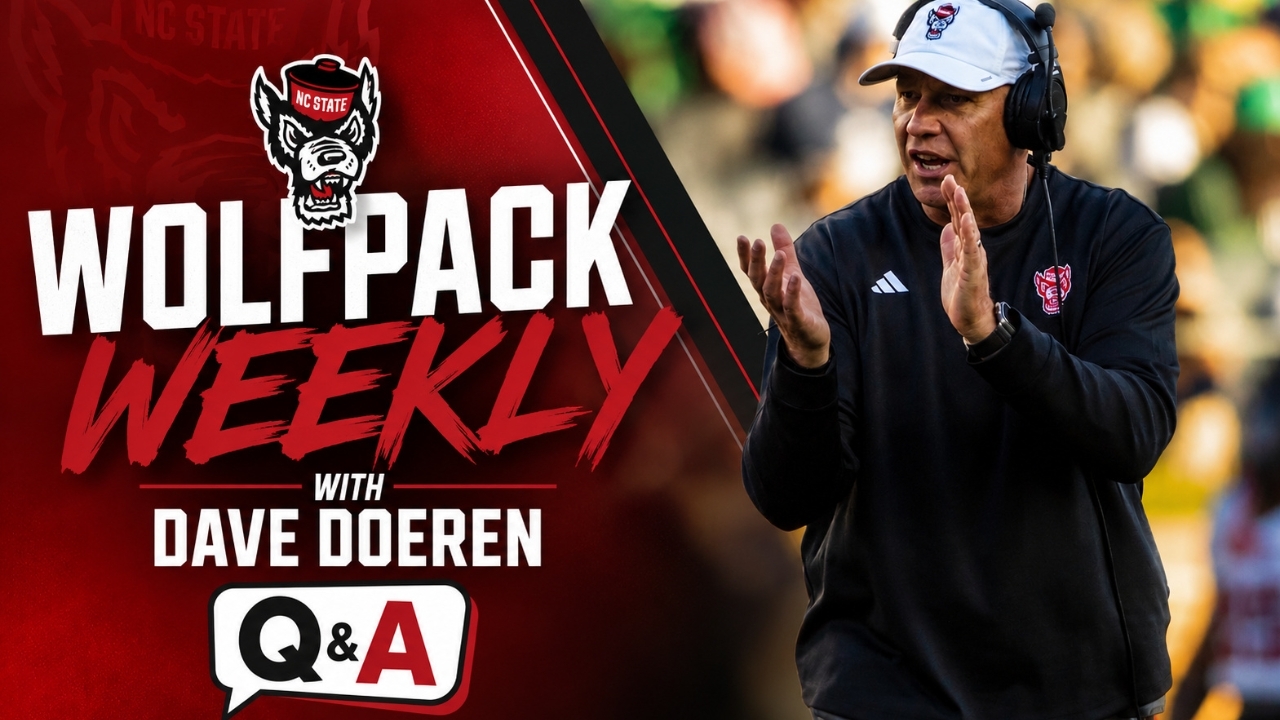
NC State head coach Dave Doeren joined the Wolfpack Weekly Radio Show to discuss the Wolfpack’s bye-week self-scout, preparation for a late-night kickoff at Stanford, young player development, and more!
You guys have a 10:30 p.m. Eastern kickoff at Stanford. Have you ever had a kickoff that late, and how did you adjust the week to prepare?
I probably have. I can’t remember when it was. Between Kansas and Montana, I played a lot of West Coast games at night.
It’s interesting when you’re on Eastern time having a transition like this.
We’ve turned into an evening-practice team. After the bye week, we practiced Sunday, Monday, and Tuesday nights from 9:30 to 11:30.
The guys got home around midnight. We didn’t have school because of fall break, which helped.
Normally, we’d be in here in the morning. I told them to sleep from 1 a.m. to 10 a.m. to get their nine hours, then report here at 11 o’clock.
The staff, too. I was talking to my wife about it. She said, “Why are you doing this?”
I said, “Because I need to be focused at 1:30 in the morning, and usually I’m asleep.”
When I get home tonight, I’ll probably be up until 2.
I’ve talked to a lot of coaches who have had this challenge, and all of them said the same thing: If you don’t do something, you’re going to regret it because the team and the coaches will not be who they normally are in the fourth quarter if they don’t prepare the right way.
Two years ago, you played at Cal, but it kicked off at 3:30 p.m. How different is this with the much later start time?
Way different.
As I said, your clock, as an East Coast person, isn't set up for this.
Fortunately, we’ve been able to have these evening practices. They’ve been awesome. The guys have had great energy.
I actually like it as a coach.
It’s pretty nice to sleep in, take your time, not be rushed in the morning, and have more time during the day to game plan.
But normally, you have school, and from a coach’s standpoint, I couldn’t maintain this schedule and keep a coaching staff because their wives and kids wouldn't like it.
For those of us who are empty nesters, it’s pretty nice.
Before we get into the bye week and football, I wanted to ask you about Chuck Amato, who recently passed away. How did your relationship with him develop over the years?
I first met him at Kansas, and we played NC State in the bowl game.
Chuck was the head coach when Philip Rivers was playing, and they had a great team that year. That was the first time I met Coach Amato.
I went from Kansas to Wisconsin, and he went from NC State back to Florida State.
We built a friendship while recruiting on the road.
Back then, you were on the road a lot. The rules were a lot different. You might spend six weeks in your area.
I was in his area for six weeks, five years in a row. I saw him a lot, and we talked.
Then I ended up at NIU while he was at Akron, so I would run into him from time to time.
Obviously, when I got here, he was retired and wanted to come around.
I wouldn’t say we were on the phone talking all the time, but throughout the years, I definitely got to know him.
Once I got here, I learned a lot about how he did things, and now several of his former players work for me.
How valuable was it when you first arrived at NC State to have people like Coach Amato who could explain what NC State football is all about?
It was invaluable, especially having someone like him who was both a coach and a player here.
I could lean on many former players and coaches.
Coach Sheridan came and met with me when I first got here. Elliott Avent is another guy who has been here forever.
I really lean into those kinds of people because they want what’s best for the school.
They don’t sugarcoat anything because they don’t have to worry about filters. They tell you how it is.
They tell you who you can trust, who you shouldn’t trust, and what's good about the city and being here.
I really enjoyed those conversations when I got here, and being able to keep them going with those guys when needed.
When you sat around and talked football with Coach Amato, especially given your shared defensive background, how much did you learn from those conversations?
On the road, we occasionally talked linebacker play because we both did it.
We never got too far into it, but when we talked about players, we probably got there more.
We’d watch a linebacker in practice while we were both recruiting and talk about the kid and what he did.
Chuck was a storyteller.
He would talk about guys he had coached who were similar.
I probably listened more than I talked in those conversations because he talked a lot, but I enjoyed it.
I have a lot of respect for older coaches.
That’s why I got into coaching. An older coach mentored me.
They’re fatherly figures. They’re full of wisdom and stories. They make you laugh. They’re tough.
I like being around guys like that.
I really respected Chuck.
As I said in my press conference, he did a lot for the game. He did a lot for many players. He did a lot for many coaches.
He deserves every bit of the recognition he gets.
Could you pull off the red shoes like Coach Amato?
No comment.
I wear what equipment gives me.
I’m not much of a guy who looks for fashion. If it’s comfortable, that’s good.
How important was having the bye week exactly at the midpoint of the season?
It was perfectly placed.
Over the years, we’ve had it after our eighth game or our ninth game, and those were hard.
Particularly with how beat up we got in the Louisville game, we needed a bye.
Whether we get all these players back or not, the guys playing are beat up, too. That’s just how football is.
It’s mental, too.
There’s a lot of mental anguish that goes on in this sport that people don’t understand.
The critics have no idea what we really deal with and what these kids deal with. They're under a lot of pressure.
Having a week where they don’t have to play a game, where they can slow it down and get back to “What do I need to get better at?” was important.
That’s really what the week was about.
It was about getting healthy where we could and learning from what we’ve put on tape.
How deep did you go into evaluating the first six games? Did you look at formations, personnel, and everything else?
As deep as humanly possible.
Plus, we use analytics and AI.
Every nook and cranny.
You’re looking at personnel. What are guys doing well? What are guys not doing right?
Can we replace that player, or do we need to improve them?
Then you’re looking at what you’re doing schematically.
What are your tendencies, if you have them?
What’s really efficient that we should do more of, maybe out of more formations?
If it’s a blitz that’s really efficient, what can we do off that blitz because people are going to be working on it? What does that set up?
Then, what isn’t efficient, and why?
Do we need to get rid of it? If not, how do we fix it?
You get all that data.
For the players, we put together what we call film lockers of their best and worst plays.
We sit down and watch those one-on-one with them so they get a detailed snapshot: “Here’s who your opponents think you are, good and bad.”
After that conversation, it’s, “What do you think you need to get better at?”
Then, lastly, “How are you going to do that?”
You create a plan.
I do the same thing schematically.
Maybe the inside zone was our most efficient run, or the outside zone, or the counter.
Great. How are we going to do it more?
Maybe this wasn’t an efficient run. Why?
Was it because the left guard did a bad job? Was it because their three-technique was really good on that play? Did they have more guys in the box, and was it a bad play call?
Sometimes that happens, too. We don’t always call great plays.
Then you look at what you should do next time. Should we have a check so we don’t run it into a bad box?
All of those conversations are going on.
Then you come up with a plan and go to the practice field, using what you’ve gathered on offense, defense, and special teams to improve the players.
Do the players respond well to seeing everything laid out on video that way?
Yeah.
When I was a player, that’s how I learned.
My coach was really hard on me, and he always told me the truth, even when it hurt.
That was how I got better. I knew what I had to work on.
I’ve always held onto that as a coach.
Our job is to be transparent and to be demanding, but not demeaning.
It’s not about tearing a kid apart in a meeting.
It’s about showing him, “Here are the areas you have to improve if we’re going to be a better football team.”
Then let’s talk about why they’re happening, and let’s find ways to improve.
That’s what players want.
They want the truth, and they want to know how to get better.
You’ve been to Stanford Stadium with USC before, though that was about 30 years ago. What do you remember about it?
I remember the band being really weird.
That’s your enduring memory of Stanford?
Aren’t they unsanctioned? Are they like a club?
Gosh, what a topic.
Let’s talk about the offense. Statistically, you’ve been one of the ACC's best third-down offenses. What's gone right there, and how do you keep it going through the second half of the season?
There are a lot of things.
The short-yardage game is a big piece, and Will and the offensive staff have put that package together well. We’ve really grown that package with Will.
The second part is that CJ is a really good thrower.
On third-and-10, he’s pretty good.
He finds guys, and his receivers and tight ends make catches for him.
Our backs have done some good things on those downs and distances, too, taking checkdowns and getting enough for a first down, or moving us from third-and-8 to fourth-and-1, where we can get the first down.
It’s an accumulation of things.
Obviously, the offensive line has protected well enough on those passing downs for CJ to deliver the football.
You’ve only had the same starting offensive line for a couple of games. How have the guys who have moved around and stepped into different roles kept the offense functioning?
I think Coach Tujague deserves a lot of credit for cross-training his guys.
His players deserve a lot of credit for being versatile because that’s not easy.
It’s a shame, because the starting five we had at the start of the year was probably the best I’ve had since I’ve been here.
We were really doing some good things up front.
When we lost Spike Sowells Jr., I still felt really good about it, with Teague Andersen, Kamen Smith, Yousef Mugharbil, and the rest of that group.
We had a good group, and not that we don’t now, but every time you lose one, it goes down.
We’ve gone from our top five to now starting our sixth, seventh, and eighth guys.
In the last game, we started our sixth, seventh, and eighth guys.
Hopefully, we’ll have Kamen back.
Spike and Yousef are out for the year, as we’ve announced.
But those kids play their butts off.
They play really hard. They care about protecting CJ and helping the running backs at a high level.
Coach Tujague has done a really good job with them.
Hopefully, we can get one back.
Next week, Rylan Vann will be back.
He’s been out since training camp with a foot injury, but he’ll be cleared next week.
We’ll get him back into the two-deep, which will help. He’s played a lot of snaps.
If we have Kamen, which we hope to, that group can get a little stronger again.
It was difficult to watch Yousef Mugharbil get carried off without being able to put weight on his leg against Louisville, given everything he's already been through. How can those previous experiences help him through this injury?
One of the hardest things in life is seeing bad things happen to really good people.
He’s a really good dude, and he’s worked really hard.
He’s been through hell, fought his way back, and become a really good football player.
You talk about good karma, but sometimes it doesn’t work that way.
That’s one of life's hardest things to understand.
God’s plan sometimes doesn’t make sense.
In Yousef’s case, he’ll come back from this injury better.
But in the moment, it’s heartbreaking because of everything he’s been through, endured, persisted through, and overcome to become a great player and a leader on our football team.
When I saw him get injured and then, in the fourth quarter, he was on his feet cheering on his team, I thought, “OK, he’s going to be OK.”
But the MRI showed much more damage than we expected, so we needed to fix it.
How much has the tight end room helped supplement the offensive line with its blocking?
That’s another group where we had eight tight ends on scholarship, and only three are healthy right now.
Some of them came in a little beat up, like Vander Ploog and Gus Ritchey.
But of those three guys playing right now, two in particular, Preston Douglas and Hunter Provience, are doing a great job for us on the run game, pass game, and special teams.
They’re on our punt team. They’re on our kickoff return team.
Those two guys bring huge value.
Tex Vaughn is getting better, too.
He’s a freshman, and he'll have to play more because of the injury situation.
You mentioned Duke Scott is day-to-day. What are your impressions of Davion Gause as a runner, receiver, and blocker?
He’s a really well-rounded back.
He can do everything.
He can play any down and distance.
He’s tough. He’s smart. He has a really good understanding of the game.
His football IQ is really high.
He’s got great ball skills. Not just good, great ball skills out of the backfield.
He likes blocking, another part of the game you don’t always see, and he’s pretty good at it.
He also starts on our punt team.
He’s another unsung hero of our football team.
How would you assess the wide receiver group, including Keenan Jackson, Victor Snow, Tyran Warren, and the others?
It’s getting better.
Keenan is playing exceptionally well.
I’m proud of him, and I’m not surprised, either.
Victor Snow is getting better. He’s finding more ways to get the football.
Tyran Warren is a really talented guy who has improved each week.
I’m excited about Tyran. He’s playing great on special teams and doing a lot to help the team.
Chance Robinson has really shown up.
He dealt with hamstring issues when he first got here that kept him from getting meaningful reps because he kept getting hurt.
To his credit, he’s figured out his health, and his confidence is soaring right now.
The touchdown catch was a big play for us, but it was also a big play for him.
I’m excited about his growth and what that can mean for our team.
With JoJo Trader out day-to-day, we need someone to fill that void, and Chance has shown he can.
We also have a couple of freshmen coming on, and we’re excited about them.
Tyreek Copper is back from his injury and has practiced for the last two weeks.
He was one of our best receivers in the spring.
Amiri Acker had a big catch in the game — his first catch — and he’s a really talented guy.
Your confidence grows when you start making plays in games, so that will help that room.
Keenan Jackson’s numbers have been impressive, but where have you seen him grow as a leader off the field?
He’s an alpha.
If you ever get a chance to talk to him, he’s a no-nonsense, assertive, direct, confident but caring guy.
He speaks from the heart. He doesn’t mince words, but he doesn’t do it to demean anyone.
His work ethic is elite. His routine is elite.
He shows up every day competitive as heck.
It’s not just saying the right things. It’s doing the right things.
Words and actions are what make you a good leader.
He’s got both.
Turning to the defense, Popo Aguirre leads that group and is one of the team’s most productive players. How did he approach the bye week? Was it more about healing, or was he still trying to improve?
The guy is a grinder.
Obviously, he’s trying to get healthier. A middle linebacker with a lot of tackles will have some bruising.
But he practices really hard.
He demands that other guys practice really hard.
With A.J. Richardson out, he knows he has to lead Ziggy Moore in that room. He has to lead Jordan Moreta.
He likes doing that.
He doesn’t see it as a tough job. It’s an honor.
Guys follow him.
It’s the same thing when you watch other guys on our team who practice really hard.
Brian Nelson II does that. Isaiah Shirley does that. Harvey Dyson III does that.
They practice and criticize teammates when they don’t put in the same effort—they hold these guys to a high standard.
I appreciate that from them.
The one thing when you talk about our defense is we’ve been a one-half defense this year.
We’ve got to get that fixed.
The kids know it. The players want to fix it.
It’s mental focus.
I talked about that in my press conference. It’s a distracted generation. It really is.
I’m not using that as an excuse. It’s reality.
When you see guys function really well in practice, and they do it well in the first half of a game, you expect them to do the same in the second half.
We just haven’t been able to do that consistently.
It’s not one player.
Different players, at different times, take their turn and don't focus.
Unfortunately for us, whoever that player is, that’s where the ball is going right now.
That’s just how it’s been.
We’ve got to fix that because I think, with how well we’re playing in the first half of these games, we can become a four-quarter team.
We have a chance to be really salty on that side of the ball.
You mentioned true freshmen Ziggy Moore and Jordan Moreta, and Elijah Satchell is in that group as well. How have those three performed while playing significant roles so early in their careers?
In this era, if you're a school like ours, your two-deep will look like this. When you don't have enough to pay another group like some of the schools we've seen, your freshmen become more available in your two-deep.
The guys you just mentioned are playing really well for us.
That’s probably the hardest thing.
It used to be that I’d have a senior, a junior behind him, a sophomore behind him, and then I’d be redshirting some freshmen.
It’s not like that anymore.
You don’t redshirt anybody now.
You go from a fifth- or sixth-year player, maybe a fourth-year player, to a first- or second-year player.
You’re seeing that with Trent Mitchell on the offensive line now.
Inexperienced players will make more mistakes.
They just are.
You have to suffer through some of those growing pains.
But I like those three guys you just mentioned.
They’re really talented young football players.