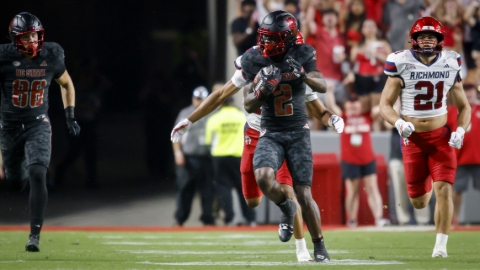
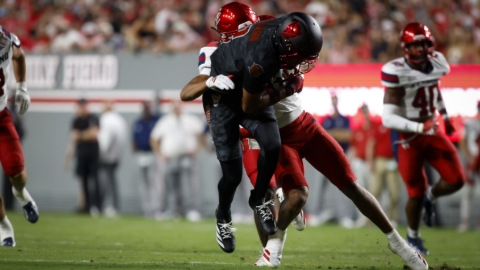
NC State head coach Dave Doeren met with the media to preview the Stanford game, discuss the new 24-team college football playoff format, and much more!
NOTE: Click the video above to watch the full press conference!
Opening statement...
All right, I would like to first take a moment to recognize and honor the passing of Coach Chuck Amato and send our thoughts and prayers to his family, former staff, and players. Chuck was an amazing personality. I had known him for a long time. I met him when I was coaching at Wisconsin, and he was an assistant at Florida State; I coached against him many times. I had a lot of recruiting experiences against him, and even when he was coaching at Akron, I coached against him.
And then when I got here, he used to come to practice every now and then and come up and sit in meetings. Just a huge personality, a great mentor to coaches and players alike, and a great alumnus. So I want to take this moment to extend our best wishes to his family and everyone who knew him, and to thank him for what he did for the sport of football and for so many players, staff, and opposing coaches who faced a guy like him. He was great at football.
It always gives you perspective when you see things like that. A bye week for us is great timing in many ways, but for players and coaches alike, after six games it gives you a chance to recover, rest, reset, and then reflect and study. Everything about our program, each person in the program takes it very personally, because your film is your resume. Good, bad, and indifferent, you have to look at every piece of it. It's who, it's what, it's why, it's when. It's a lot of analytics and a ton of film. And so it's a tedious but fun process of going through with the staff and the players each part of every game.
And it's been great to be able to sit back and take the time, without a game this past weekend, to look at it, and then build a plan to move forward from there and get ready for the six-game season we have left. Each person in the program has been assigned specific areas for improvement, and aggregate growth is the fastest way for the team to grow. If you take 80 players and each improves one thing in their game, that's an 80-fold improvement. And the same thing goes with the staff.
When you look at your tendencies, when you look at the details, when you look at how people are attacking you or where you're having success, where you're efficient, where you're inefficient, try to make those things more efficient for our team. And it's a chance to get healthy. Coming out of the Louisville game, we played maybe our best football of the season and then lost several starters in that game, and the depth of your roster is a critical piece. We hope to get some of them back. We're day-to-day on Kamen Smith, JoJo Trader, Duke Scott, and Tristan Teasdell. So it could be any day; it could be this week, it could be next week. We hope to have all of them.
The negatives: Yousef Mugharbil suffered a significant leg injury, and that will end his season. I feel terrible for him. He was playing so well, has been such a great leader on our offensive line, and has been through a lot. For those of you who know his story, what he went through at Florida is pretty significant. The good news is that he has a year to fully recover and have a great season next year. But in the moment, it hurts to lose such a good player on the offensive line.
And then Vander Ploog, who hasn't really gotten significant time, had a bad shoulder coming in and couldn't get it healthy. He'll be out for the rest of the year, but will return fully.
Getting ready for a road trip to Stanford, a Friday night game at 7:30 Pacific, which is 10:30 Eastern. Thankfully, that's a challenge. Obviously, you're playing at 1:30 in the morning in the fourth quarter. So we've done a lot of research on these east-to-west coast trips in the NFL and college. And thankfully, we have fall break, so there's no school here Monday or Tuesday, which allows us to change our routine and practice in the evenings. We did last night, we will tonight, and we will tomorrow night. So we're out there at midnight practicing, and we had incredible energy last night. The guys did a great job.
The goal of this is to understand how to play at that time of evening and under the lights. It's been pretty fun being out on the field with them. But to be ready for that 1:30 a.m. fourth quarter, I was talking to a coach in our league in the offseason who had been out there the previous year and played in the same time zone, and he said, "We played pretty good until the fourth quarter, and then it was 1:30, and our guys just didn't have it."
So that got my wheels spinning on what we can do to get our guys ready, because we're normally a morning practice team, not just for a night game, but a night game that's three hours later than our body clocks. That's what we're doing, and we're looking forward to the opportunity to go out there and play Stanford. That's the first time I've played there since I was a graduate assistant at Southern Cal. It's been a long time. It's a beautiful campus and a great opportunity for our guys to go out there and play them.
First-year staff, you can see that they're getting better on both sides of the ball. I can't say enough about their defensive tackle, No. 75. What a great football player he is. I thought the same thing last year watching crossover film: just a disruptive, athletic, big, strong guy who does a lot on the line of scrimmage. Both defensive ends are really thick, strong guys.
Their running back is a downhill guy, a 225-pound back who had a really good game last week. The quarterback can make all the throws off the run game, NFL-like. There's a lot of movement, play action, move-the-pocket type plays, and down-the-field throws. The tight end is a really good player and gets the ball quite a bit. It's going to be a good matchup.
Playing on the road and coming off probably their best game against Elon, I thought they played really well on both sides of the ball.
Your bye-week goals change year to year. For us, it was getting as healthy as we could, taking advantage of the film, and becoming a team that can eliminate other lack-of-focus issues we've had in the third and fourth quarters, as well as some of these lapses.
To me, that's really the most frustrating thing as you go back and look at it, because that's never been an issue here in my time. We've always been a really good finishing team. It's part of our DNA. It's what we talk about. It's how we train. It's how we practice, having grit and persistence in our blood, and that will get fixed. It's something the players and leadership are working really hard on to make happen.
How does it get fixed? It's a choice. Guys have to choose to focus better. And these are things that, with today's youth, you see across the country as you watch college football — there are a lot of mistakes, and attention spans have gotten worse and worse over the years. So it's just something you've got to be really, really cognizant of with your guys and continue to impress that on them. Leadership is always the most critical piece. When your leadership guys are beating that drum as well as your coaches, it helps, and that's happening.
Six games left, like I said, one at a time. We look forward to the opportunity to finish well, and we take great pride in that, starting this Friday. Questions?
I did want to ask you a little more about Duke. You mentioned that he's day-to-day, but when the depth chart came out earlier today, he wasn't listed. Was that by chance, or is there something bigger going on?
No, he's day-to-day.
Okay. And as far as the travel plans, I did want to ask you about that. You mentioned there are slightly different travel plans going into this week, but how different are those plans, and what went into those decisions?
Yeah, when we went out to Cal a couple of years ago, we went out two days early to acclimate to the time change, and we'll do the same. We'll fly out there on Wednesday, land, and then we'll practice Wednesday night again at game time, just to get used to the clock piece of that. But it worked well for us when we went to Cal a couple of years ago, so we'll follow that same routine.
Doeren, you mentioned a lot about reflecting during the bye week. What is the biggest thing you've learned about yourself as a coach through these first six games, just managing all the ups and downs you guys have dealt with?
You have to move to the next opportunity. There's only so much you can do, and focusing on what you can't control doesn't help. I think as you look at all the things going on when you're a coach, outside of what really matters, what really matters are your players and your staff in the building. And so that's the biggest thing I've tried to do: stay grounded in: What can I do today? What can I learn from yesterday? What can I do today, and how can I make tomorrow better? And not worry about anything else other than my family and the things that are paramount to me; that way.
We've got some awesome players, man. I love coaching these guys, and our staff's working tirelessly to give them the best plans we can, and we stay focused on that, just getting better. And I felt like we were—the App State game, the Louisville game—as you can see, there was a lot of improvement. Then we ran into a really good football team in Wake Forest, and played well for a half, but the injuries really set us back in that game.
So with the bye week, trying to get as many of these guys back to full go to have a great finish, I think there's nothing you can do about that part of the game, especially when there are concussions and critical injuries on game day, but get the next guy ready and then look at: Here's the guys we have. Things might change a little bit with play calling or by featuring other players who are playing well.
Yeah, you've touched on the changes to the schedule and all that, but looking at the bigger picture, how significant has your operations staff been, including Kevin and Juliana, in handling the program's logistics, especially on a week like this one?
Yeah, no, they do a great job, and that staff went through it in the summer with the Brazil thing. So, they've been through a lot. I can't say enough about Kevin, CJ, and Juliana. The three of them work really well together.
Taking your football team across the country is a big undertaking, with many moving parts, planning, time, phone calls, and due diligence. So I'm very thankful. I appreciate you shouting them out; they do a tremendous job. I've been fortunate to have had several people in that role over the years, and they've all been the same. They're super professional; they're people first, and they get it. So I'm thankful to have the crew that I do, and I know this trip will be no different. They'll do everything they can to make it first-class for our guys.
I have two somewhat related questions. One, you've obviously been coaching a long time. Do you feel like the sort of referendum on a week-to-week basis has changed from maybe when you started? People used to let a season play out, and now it's "Did you win, or did you lose?" And you see it not just at your place, but in Texas and all over the country.
And then, secondly, I wondered about your thoughts on the 2014 playoff. And obviously, your school's been shouted out a lot as a team that may have benefited greatly from having a 12-team playoff in the past. Do you think that would help schools like yours or others in the ACC in particular?
Yeah. Your first question: I'll give you a Ruffin McNeill quote: "When you win and have a great season, people want you to write a book; when you lose, they don't think you can read one." I think that's more true now than ever. I watched college football this weekend, and there were a lot of upsets. Every time you put that ball down, anything can happen.
It's always been grown-ups coaching young people, 18 to 22, and their ability to succeed and make plays in key moments dictates the outcome for many of the people who coach them. Your livelihood depends on young people, and that's why we do this. We love helping them; we love mentoring them, coaching them, leading them.
But with that comes a lot of backlash. When a young guy makes a mistake in a game, all of a sudden you're an idiot just because he did. And trust me, there aren't any coaches at this level who aren't really good at what they do. None of us are perfect; we all make mistakes. But there are a lot of really good football coaches in the ACC, the SEC, the Big Ten, the Big 12. I mean, I run into these guys all the time, and we're dealing with a lot of things, sometimes out of our control, sometimes not. It's just the way it is.
You can get really frustrated by it all, or you can understand that that's what sells, that's what gets clicks, that's what your job is as media, to get storylines. So we understand that. Some of us understand that better than others; I certainly do. It doesn't mean I like it, but I do understand the media's responsibility. There are far more negative stories than positive ones in the world in general, and college football's no different.
When it comes to the playoffs, I think it's great. I've said this before: access is what's most important for teams. Having the ability to be a playoff team in the postseason — the bigger the playoffs get, the more that matters over anything, probably over bowl games. The relevance of bowl games, I don't know where that goes. With 24 teams, that'll be an interesting part of this to follow.
With an FCS background like mine at Montana, I made the playoffs twice and went to back-to-back national championships. So it was a part of the longest run you can have for a season, two years in a row, and the playoffs were awesome, man. They were on college campuses at that level. The home environment, the way that it was in the stadium, the Sunday after your last regular-season game when you're finding out what your seed was and what brackets you were in and who you were playing, it's really cool.
So to think about that on a larger scale with Power Four football, I think, is awesome. I'm super excited about it. And, yeah, to your point, I think somebody said we would have been in five times. So, it does a lot for programs like NC State.
Yeah, Coach, I think when NIL first started, coaches wondered how it would seep into the locker room, the discussions about it, and those kinds of things. You've now had three or four years of it, plus revenue sharing. Have you noticed it being an issue in the locker rooms as the season goes on?
I don't think it's really an issue as the season goes on. It was a bigger problem early on, certainly. Kids didn't know; they'd never been paid before, didn't know how to handle that. And there was a lot of discussion with them, education with the players, that your business needs to be your business. When you have comparisons going on downstairs or even in your business office, if people are bitching about what they're making, complaining to others, or talking about what someone else makes, that's not productive for anybody
And so, just educating them on how to handle those — those are business conversations for them to have with their parents, with their agents, or their counselors, or their high school coach, if that's who's helping them, but not locker room material. And I think as it's become the norm now, they're used to having money, not saying that they don't try to find out what other people make; they probably do. But I don't hear about the discussion issue as much as I used to. That used to be a bigger problem when it first started.
And just a quick follow-up, kind of on the same note: motivationally, have you noticed it being an issue when guys maybe did have a big breakout year and benefited from it, but then didn't have that same motivation coming back the next year?
I haven't really seen that. I can see why that would be something that people consider, but I think the way this is going, the guys, like anybody, want to make more. So when they succeed, they want to succeed again and do more. It's had the opposite effect for some guys. You see it on teams where their seasons maybe aren't going as well, but the kids are playing really hard because they know there's earning potential. Even if they're not winning, whether they stay at their current school or decide to leave, good film matters when you're talking about the money they can earn in this sport at the college level.
So I do think it's been a good motivating factor for a lot of players; can't say for all, on good teams and bad teams, and you see it across the country, even at these FCS programs. Those kids, a lot of their coaches now are actually saying it to them when they recruit them: "Come here and play well, and we'll help you get a scholarship and make a bunch of money at a Power Four school." You see it in the FCS as kind of a sales pitch. So I think it's been pretty motivating for a lot of them.
You've been able to see some of the walk-ons on the scout team for a few months now. What is it like when you have those tryouts in January and February, and you see some guys who may have tried out over multiple years?
Yeah, Castaneda is a guy we got in a walk-on tryout; he started on our field-goal protection team last week. A guy that we found in February in a 6:00 a.m. workout. I love the walk-on part of college football. I hate that it's becoming diminished now with the 105-piece. You're going to see a lot of rosters getting smaller as the grandfathered walk-ons graduate out of college football, because anyone you add to your team, on scholarship or not, counts toward your 105-man roster limit, which is your max unless the kid was a grandfathered walk-on.
We used to have 85 on scholarship and 40 walk-ons at NC State; we were 125. That was our Title IX number. Out of those 40 guys, there'd probably be four or five who were through walk-on tryouts each year that we would add. And occasionally, one of those guys would really make a difference. They all help us on the scout team, and the look teams te have for prep, but sometimes they elevate themselves into playing roles. And Castaneda is a great example. He's our scout team center; he squats over 600 pounds, a really strong kid, and with the injuries we had up front, he was a guy that we thought could help us on field goals, and he's done a great job.
Yeah, Coach, when you were talking about Chuck and him coming to practice and getting to coach against him, are there any specific memories that really stick out to you from your relationship?
There's a lot of them. Chuck, as you guys know, had a huge personality, a really unique voice, and always had great style, always well-dressed. I mean, I remember seeing him out recruiting; he was always one of the most well-dressed guys, super friendly. I was much younger than him, and he would always come over and talk to me when we were out in the field watching recruits.
And he was just a guy who mentored coaches. Even when he left NC State and went back to Akron to coach with Bowden, we played them when I was at Northern Illinois, and I remember just talking to him. I'm like, "It's pretty impressive that he stayed in the game and wanted to coach." He loved football. He loved being around coaches. I remember when he called: "Hey, Dave, I just want to sit in your defensive staff room and listen. I love football; can I do that?" I was like, "Yeah, please do." And that season we'd see him every now and then; he'd come over and hang out.
Yeah, it's just an awesome personality. There's a million stories, I'm sure, and things that people remember about him — his glasses, his shoes, all those things that people remember about Chuck. But I remember just the type of guy he was to a coach. I was a Division III player; I wasn't anybody, and I was coaching linebackers at Wisconsin, and he was a linebacker coach at Florida State. And we just started talking football one day. From that point on, there was always a bit of a brotherhood between him and me when it came to talking about defensive football and Florida recruiting, because that was my area for five years. And so you build kinship with those kinds of guys.
I look up to my elders in this sport; I always have. I've always gotten a lot of wisdom from guys that have been in it longer than me, and Chuck was one of them.
Coach, Ziggy got his first start last week. What did you see from him, and, obviously, from his growth throughout the year so far?
Yeah, I'm proud of Ziggy, proud of Moreta. Both those freshman linebackers are playing good football, and they both have roles. Ziggy is a physical guy; he's a really good blitzer, and his knowledge has gotten better.
We got him on special teams a few weeks ago, and he started making plays on kickoff. You could see his confidence going up from there. This felt like we needed more production. That spot where we lost Richardson at the beginning of the year is, man, a WILL linebacker is a critical piece in our defense. And so getting somebody who can run a little bit better, tackle a little bit better, is a little bit thicker, and has a body type — Ziggy was a good fit for that. And Moreta, too; those two guys will help us throughout the year and continue to improve.