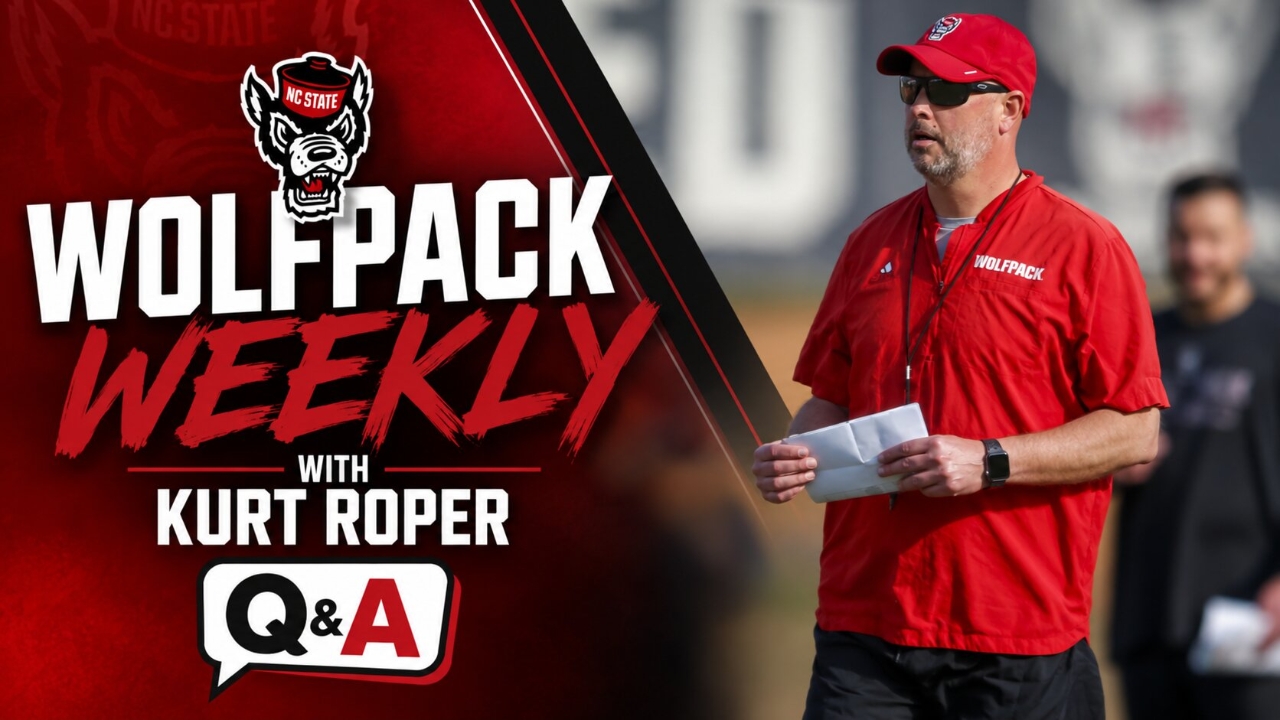
NC State offensive coordinator Kurt Roper recently spoke on the Wolfpack Weekly Radio Show, where he discussed helping CJ improve after the Virginia loss and the Vanderbilt game, and much more!
So, your third or fourth quarter, it's late in the night after a 90-minute lightning delay. Noah Moss or Dylan McCoy, one of the running backs who is maybe or maybe not going to play against Vanderbilt, but one of the ones who you'd think would be part of the depth of the depth chart. Are you up there thinking, well, gosh, what play should I run here right now?
I wasn't sure we were going to get into this situation, maybe hoping to, but what's it like play-calling when you're playing 85 guys in total? Not all on offense, but you're really deep in the depth chart. What's play calling like in a game like that?
Well, I think the mindset was still about getting guys ready to play down the line, in case the need comes up for them to play. So the first focus was getting Will better, letting Will execute the offense, and running plays where Will's going to have to, if we're in a situation where it's still a competitive game. That was the focus.
And then once it switched to Tad, now it was just trying to put good, structured runs out there and letting our guys be physical and try to make plays.
I'm glad you brought that up because even though the game was out of hand, you guys were still able to create some football situations. This was their first opportunity to get in a two-minute drill with CJ. How did you like that?
This was an opportunity, as you mentioned, for Will to expand his game beyond just being a rushing quarterback. He threw the football, threw his first touchdown pass, right? From those standpoints, how pleased were you with those two guys and how they functioned in those situations?
Yeah, I thought we did well. At first, the two-minute drill was important for us to execute as a new offense in a lot of spots, having to play fast, manage getting out of bounds, manage timeouts, and all those things. So I thought we did a good job there.
And then I thought Will did a good job coming in, just playing football. We asked him to do more things, and I thought he handled it well.
That touchdown pass is not an easy throw.
No.
But it's one of those you knew was coming: the little fake run, then the pop pass to the tight end.
From an execution standpoint, I know you guys work on that a lot, but sometimes you get in games, and the adrenaline takes over. He handled that perfectly.
I thought so, too, and it's obviously been part of his package and will be going forward. Those things are never easy, but you like to see the execution.
You've been a part of some great offenses. You mentioned that Florida game. Great programs, great offenses.
The best running backs seem to have this knack. It's like they never get hit really hard, right? There's just this amazing ability.
There are 11 guys trying to go get you, and they'll go down eventually. You're going to go down, but they never get the big de-cleated hit, and Duke Scott seems like he might be one of those guys. I feel like I can't remember Duke Scott ever taking a big hit.
What is it about the best backs that it seems like one of the skill sets in durability and sustainability is that, as many times as Duke touches it, he seems to never take a ton of big contact?
Well, I think the first thing is that there are probably big hits taking place, but when you're built like Duke and really good running backs, they don't feel it the same. They add to it at the same time, so their forces are different. On Duke's touchdown run, the defensive end was unblocked.
We knew he'd be unblocked. It was CJ's job to try to hold him as long as he could, and that's a good football player. That guy made a lot of good plays on the field, and I thought he brought a lot to the party.
Duke brings a lot more. He's compact. He's wide.
He's powerful. He's strong. I've said for a long time, running backs, they're different people.
They run into people for a living, so they're not built like you and me. It's a different mentality, and when you play the game the way they do, sometimes it takes till Thursday of the next week for them to feel good.
Coach, you mentioned we've got Duke, but also when you get to see Davion Gause score a touchdown, the Noah Moss one didn't count, but it was still, hey, you put that on tape, and then the Jonathan Paylor 51-yarder. From that standpoint, being able to work guys in there that you can talk about being ready, but that was an example of them being ready, right?
Well, they're talented football players. It was fun to watch. They look fast from my vantage point, and you never know when they'll be needed to play a football game. But I think you see we have some good young talent on this football team, guys that can really run.
Here with offensive coordinator Kurt Roper, it's Wolfpack Weekly. Is part of being a great offense being unpredictable pre-snap, and is part of being unpredictable having balance between run and pass, so the defense doesn't know what's coming because your personnel package doesn't tip their hand?
Well, I think if you manage down and distance, you have a chance to be more unpredictable, and the run game helps you do that. I go back to how I learned this game. Every formation that you had, you could run it to the boundary. You could run it to the field.
You could run it between the tackles, outside. You could throw the football. So in your formation chart, you had to present everything to the defense.
They couldn't just look at your formation and say, "This is a run," or, "This is a pass." And so you still try to build that. Offense has changed over the years, with a lot more movement, a lot more motion, and faster motions.
You don't format quite like you used to because you're creating so many different looks to the defense. But our best advantage is this: if we can manage the down and distance, you'll never know whether we'll run or pass. When we get behind the down and distance, that's when the predictability comes.
You could say every game, part of it, key to the game, has to start fast, has to start fast. From an offensive standpoint, to get that first completion from CJ, a positive play, you get an explosive play, but for CJ, did you want to get him on track after the Virginia game to get the mentality of, " Hey, I'm a good quarterback. Can I still play this game? He had a very efficient game and a good game against Richmond.
I didn't really think about that in those terms. I think our focus coming out was to shorten the distances, run the ball, and put together a plan that lets him play quarterback without putting all the load on him. Everybody understands that in this game, the quarterback is important, and he's going to be critiqued and praised. One week doesn't just set who you are, if that makes sense, and I think we talk about that stuff all the time.
You better build the right mentality in this game. I'm sitting here reading this week, Baker Mayfield went 23 of 28 for however many yards and signed a huge contract, and everybody's saying, "Is he finished?" because he had three turnovers. That's how football gets judged week to week, and we all understand that you have to insulate yourself from all that.
So how did you handle CJ after the Virginia game?
Next week. We go in, and we make the corrections.
Our corrections are technical, not emotional. Once we make the corrections, we remove the rearview mirror and move on to the next. We don't have time.
We've got to now get ready for the next game. And so we played the Richmond game. Same thing. We learn from it, and you're on to the next.
We're making decisions right now on third downs and third-and-long, third-and-medium, short yardage. I'll go right back up and spend the rest of the night trying to figure that out. We're not thinking about Richmond.
That's over, and so that's how a quarterback has to build his mindset.
What kind of weapon will Victor Snow be this year once the season starts? What are his abilities as a chess piece on your board?
I think he's a really talented football player. He has really good hands. He's strong.
I'm hoping he's a guy who, when he gets the football, can find extra yards after the catch because he's powerful
You look at the receiver position, everybody wants to know who's going to be the guy to step up. Keenan Jackson, with the game he had, is something we've seen before, but it's a career day for him as he moves up the depth chart, so to speak. He's always been going to be the starter, but to see him play the way he did against Richmond.
Well, it just shows they've been together a while. He knows our offense. He's been in the offense now, and he is the leader of that group, and we were able to hang our hat on him last week.
Vanderbilt Commodores. Got you for another minute or so here. What jumps out? What early on, first quarter, are you going to try to get a feel for when you're play calling here against Vanderbilt?
I think they're a very physical football team. I think they're a multiple football team. I think you watch their inside linebackers.
They can run really well. Their boundary safety is a physical player. They like to try to play on your side of the line of scrimmage, and so it's a great challenge. But I think the thing that jumps out at you is it's going to be two physical football teams going at each other.
They like to crowd the line of scrimmage a lot on defense. Sometimes there are seven. Sometimes there could be eight on the line of scrimmage.
You don't know who's coming and who's dropping. What's the decision-making process there for a quarterback to figure out where they think the pressure might come from and who might drop?
Well, as a staff, we've got to try to structure things as best we can to give him those answers. He's got to use his indicators to try to understand those things that could happen. Who's coming?
Who is a part of the pressure? Who's going to drop? But that's what we're spending our time on this week, trying to structure things to help him as best we can.