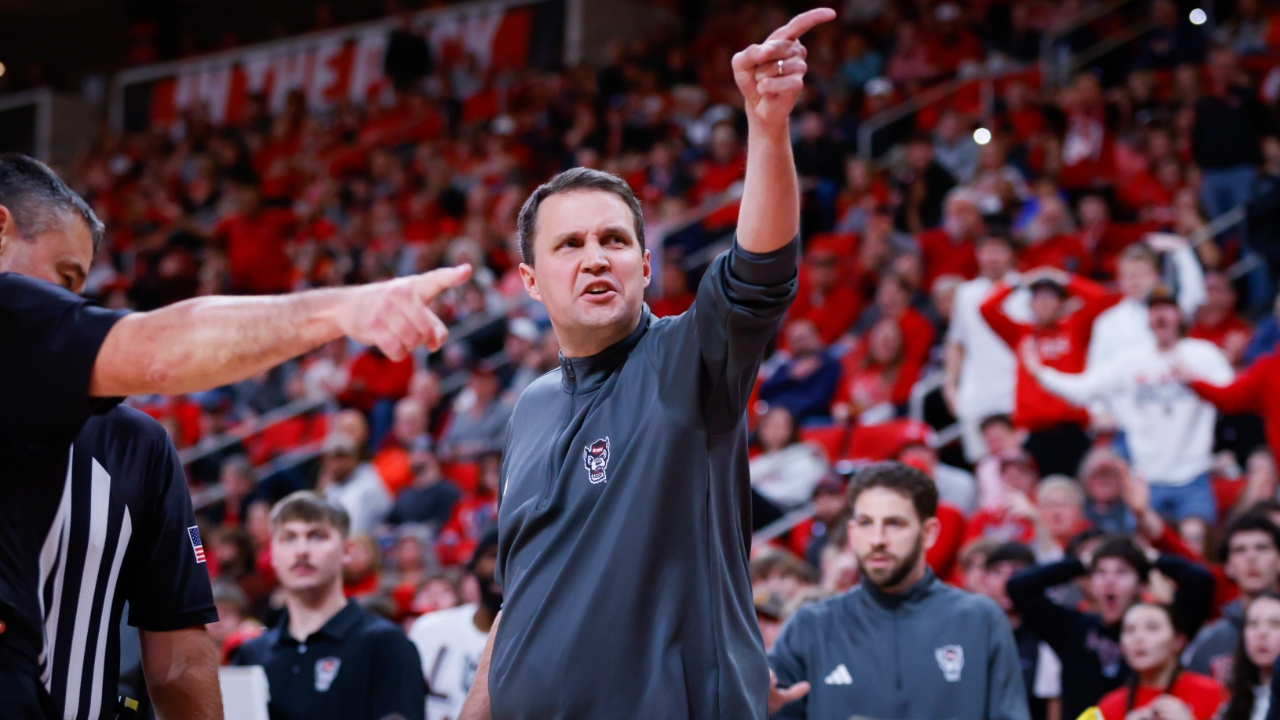
NC State head coach Will Wade met with Wolfpack Sports Network for his weekly radio show. He discussed his "five-game standards", Paul McNeil and Quadir Copeland's development throughout the season, and much more!
NC State coach Will Wade is off to a 6-2 league start here and is tied for third place now in the ACC. Congratulations on the recent wins since we last spoke. Coach, we've got a couple of games to recap, Pittsburgh and Syracuse. How has practice been since, how's practice been today? How's practice been since the win over the Orange?
Practice today was solid, we had a good spirit to us, we need a little bit better attention to detail, but we had a good spirit to us today and hopefully tomorrow morning when we practice we'll have the attention to detail that we need to go with that spirit, but I thought today was solid.
We talked about it before Syracuse for a few minutes, but we can dive a little deeper here with a little time, 81-72 on the road. How impressed were you that you scored in the 80s with only one made field goal through a quarter of the ballgame?
We were terrible to start the game. We just got off to a slow start. It was five to nothing to start. Our side out of bounds defense saved us. Our first couple baskets were off steals on side out of bounds.
We did a good job on our stacker jumps on the ball, but we didn't have the pop that we needed. They blasted us on the glass. We didn't rebound. We didn't have the physicality, especially against 13 and two. Those guys really hurt us. It wasn't a great start, but we hung in there. Paul made some shots, and we dug out a win. It's the end of the day. There's no pictures on the scorebook. Just win.
Siulepa and Corhen are 13 and two. Those are the two guys I think you're talking about who were monsters on the glass.
13 hit some tough threes. We had two contested threes. Q contested them. They hit some tough threes. Three hit a couple off the bounce threes that were tough. They made some challenging shots, but we also didn't help ourselves very much.
We were fortunate to win. You play like that most nights. You don't win. We were very, very fortunate. We were very, very fortunate to win.
You mentioned something pregame that relative to rebounding, you said you really didn't have a problem with rebounding disparity as long as you don't turn the ball over.
Well, I do have a problem with rebounding disparity. I said you can win if you don't turn the ball over with the rebounding disparity. I would like to win the turnovers and the rebounding.
I think you're undefeated when you win the rebounding this year. I believe it's 11 and 0 is the mark when you've won the rebounding battle. You're 24th in the country in fewest turnovers committed per game, just under 10 on average. Right around 10 on average, fewest turnovers committed per game. You gave up 26 offensive rebounds to Pittsburgh.
Let me ask you a trivia question.
I'll do my best.
Do you know what our highest turnover game in ACC play has been so far?
Was it Wake Forest?
Wake Forest in game one. We turned it over 15 times. 20% of our possessions, we turned the ball over.
Won the game by 13.
Won the game by 13. It was our worst offensive output, it was our worst offensive rating, it was our second worst effective field goal percentage, it was our worst turnover game, and we shot one of 13 on mid-range jump shots because we fell for the bait on their defense.
So, we got a lot of work to do between now and Saturday to make sure we don't replicate that poor performance on offense. While you're excited about only 10 turnovers a game, our highest turnover game was Wake in game one, where we were really, really sloppy.
There's a little bit of tug-of-war that goes on on this show sometimes. I kind of throw a positive nugget out there. Coach kind of volleyballs it back.
I live in reality.
I like my reality. Coach, you're 6-2. You're off to the best start in the fifth of a century.
We should be 7-1.
Okay. All right. All right.
If we were 7-1, I'd be a little bit more pleased. But we should be 7-1. It's not about... See, that's the problem. I ran our guys today for the Syracuse win because we only got two of our five game standards. We ran three 3-22s at the end of practice.
Yeah. So that's the problem. You get intoxicated with the final result.I do. Just the winning. It's how you do it. If we go on the road at Wake and get two of our five game standards, we're probably going to lose.
So you have to play to a standard every game. And while you're all excited about beating Pitt, that effort... And we get off to... We have that start at Pitt that we had. We have that at Wake. We'll be down 20-2, not 5-0. Other teams are more capable of taking advantage of some of that.
So I choose to live in the real world.
So we're postgame or we're toward postgame in Tallahassee. And you're up big in Tallahassee. It was what? 114-69?
Whatever. You love that game. You talk about that game every week. You weave that thing in every week. That was like a month ago.
And I joked with Chucky on the air postgame. I said, should I start your postgame interview with, Coach, what went wrong? You hit 19 threes. You set a record for shooting.It's one of the great offensive performances in the history of the ACC. And I was thinking, Coach, what went wrong today? What was wrong? But I mean, a lot went right in that ballgame. But it did.
So we ran today for how we played against Syracuse. So I know everybody's all excited about the 20-point win or you're excited about the 20-point win.
I am excited about the 20-point win. I stand by that, by the way.
There's certain standards you have to play to and we didn't do it.
Take me through the five game standards.
No, they're pretty simple. Twelve or less turnovers. Okay.We got that one against Syracuse. Forty plus deflections. We did not get that one against Syracuse. Win the rebounding battle. We got that one against Syracuse. Five plus turkeys. A turkey's three stops in a row, like bowling, the turkey comes up there when you get three straight strikes.
So you get five plus turkeys. That's the fourth. You got that? And the fifth one I change per game. But this one was win transition by eight plus. We only got two of them. We got 12 or fewer turnovers and we won the rebounding battle. We didn't win the transition battle. We didn't get five turkeys and we didn't get 40 deflections.
Thus, you run. But I tell our guys, I'm fair. If we lose and we get three of the five, we don't run. If we were to get three of those five and lose, which is statistically almost impossible. It's not. It's improbable. It's not impossible, but it'd be tough. But if we lose and we get three of the five, then you don't have to run. What a deal.
And you cater the fifth one based on matchup.
Yeah. Usually it has something to do with free throws or toughness. The transition was this because we felt like we had an advantage in transition and their best offense was in transition, so we wanted to win the transition and we didn't win it by eight plus. I think we won it by six.
So you need to win it by a certain amount. You can't just win it. You got to win it by a certain number.
High standards.
That's good. And it's working. It's fantastic. Six and two start. Three way tie.
Should be seven and one.
Should be seven and one. Up, what, nine second half Georgia Tech. And I know that one.
Yeah, and we gave up a corner three at the back end of our press to Reeves. In the left corner.
Of all the shots this year, that's the one that.
We rotated up on a. We trapped up. You're never supposed to trap up on a stack side. We trapped up on the stack side. Our back guy takes the first guy in the stack. We leave the second guy in the stack. The best shooter. The first guy in the stack is a horrible shooter. So, of course, we rotate to him. And we leave the good shooter open. And boom.
Yeah. No bueno. No good. Not good. Memorable for. So, it's because it's process driven. It's about. That's what you're telling me. It's about process. Not end result.
I mean, Virginia beat us. I can take it when we get beat. They beat us.They beat the breaks off of us. We didn't deserve to win that game. They were better than us that day. They posed some match up issues for us. So, I can take my medicine when I need to take my medicine. Medicine left a funny taste after that Georgia Tech game.
Not what you wanted to deal with against the Yellow Jackets. And a home game. I know you've talked a lot about reestablishing home court. That felt good. 20 point win at home against Syracuse.
It was good. Our students were great. Looking up at the student section on the far side and seeing it all the way up. But, yeah, I thought it was great. I thought it was a great crowd with the, with the snow and everything going on. So, yeah, that was good. It was good to win back at home. We've lost three home games, which is not good.
I thought it was a great contingent even at Pittsburgh. And Boston College, I thought, it was.
Yeah, Boston College, we had the Wolfpack chant going.
More so than the Eagles were cheering. There was a contingent of folks in Chestnut Hill.
It would be an interesting crowd on Saturday. Not going to be many folks with the snowstorm, I would assume.
Oh, speaking of which.
It's at noon, right?
We have breaking news. Yeah, there we go. There's our breaking news stinger right there from our guy, Mad Dog. We have breaking news. The tip time changed for Saturday to noon. So, let's see here. Anticipated inclement weather Saturday, January 31st is the official announcement.
Atlanta Coast Conference has announced game time change for the Pack and the Demon Deacons. We played in the Joel game. It's at noon Saturday. So, 11 a.m.
We've been great at these noon games.
Noon tip against the Demon Deacons.
It's funny. I was actually meeting today with our staff on redoing some of our routine for our noon games to try to get us off to better starts. And then, boom, they hit us with a noon tip off.
They flipped you. Like routine on the day of?
Yeah, on the day of. Just in terms of sleeping patterns and some of that sort of stuff.
How much do you think that contributes to slow starts?
I don't know. We're going to find out because we're going to change it up for Saturday.
Switch it up?
Yeah, we're going to switch it up.
When did you start to lean into analytics? Because analytics hasn't always been around in college athletics. When did that start for you? When did you latch on to it? When did you sense that it was something that you thought was valuable enough to use as something to change the team?
Well, everybody just puts fancy names on stuff now. I mean, analytics is the fancy name everybody's put on that. But you always are trying to explore the most efficient ways to do anything, right? I mean, I think the best businesses, the best anything in any industry are the most efficient. So it's all about improving your efficiencies. And there's some things I'm trying to do with our team right now to improve our efficiencies.
There's a way I think we can claw back almost seven points a game that we can claw back over the next couple of weeks that we got to work on a couple of things. And we're going to start implementing that. So you're always trying to look at efficiencies and work on efficiencies. And so it's kind of natural. I'm a linear thinker. And if it makes sense, I like to go with it.
But take me back as a grad student at Clemson.
I don't think there was none of that.
There was none of that then. It didn't really exist back then.
No. Really, when I got to VCU was when it started. When I was a head coach at VCU, we had all these graduate assistants. We had some guys who came from the NBA. We had some guys who had a little more knowledge about that.
And they sat down with me and showed it to me.I was like, yeah, this makes sense. Pretty cool. And at your place like VCU, you're trying to compete with the NC States, the high major schools.And so you have to have some sort of edge.
You can't just line up and beat them. And so you've got to have some sort of edge. And I thought that maybe gave us a little bit of an edge or gave us something that we did different. And so we tried to do that as best we could.
OK, so year to year, you've been at it now, analytically speaking, since VCU, we'll say, which is a good bit of time. You've aggregated a lot of data. Do teams surprise you now?
Does this team grade out, or is the data around this team what you thought it would be at the start of the year? Did you think it would go the way it's gone relative to your expectations of who you recruited, how you recruited them, how you put the team together? Does that question make sense?
Yeah, I mean, shoot, you always think it's going to go better than it goes. I mean, look, we're all right. But I thought we'd be a little bit better.But how about the way you thought you'd be? I mean, the numbers are pretty close. And we've played a lot closer the last month to what kind of I thought we would be.
But not everything's done on paper. You have personalities. You've got some other stuff.And some of that was maybe a little bit different than what we were expecting. But hey, that's all part of it. We have to adjust. And look, you can't ask for a re-deal. You've got the cards you've got. So you've got to play the cards you've got, and play them as well as you can.
So it feels like the way it's kind of gone, and I think this is typical. This is not an NC State unique thing. You start out, your rotation's 10, 11 guys, maybe even more like first game of the year. You're up big against NC Central.
You're figuring out what's what. And then it starts to funnel down a little bit, trying to win as many games as possible, figuring out what you got. And you get toward league play, and it shrinks down even more. Now you're about eight.
We talked about this before Pittsburgh. You feel good about an eight-man rotation. And then you refine that and perfect it, try to peak in March. That's kind of the arc.
Yeah, I mean, look, we've got a ninth that can play, and a tenth, and Scottie. Scottie's back. He practiced today, so that was good to see him out there.And Alan's ready to play. It's just we're winning, and you kind of stick with the nine-man.
But there's going to be a time where we're going to need Alyn this year. Alyn's going to be back in the rotation, I believe, at some point. Because what happens is some of these guys, they get comfortable. And the only thing that gives them some discomfort is sitting on that bench. And so you've got to have that. And so when Alyn comes back, he's going to be much more appreciative of whatever he gets.
Sometimes you get a little entitled. Not that Alyn got entitled, but some guys do. And now we've got some guys that are getting a little used to playing that are relaxing a little bit. So you can just keep moving them in and out. That's the way it works. And so I can sense that. I actually talked to Alyn as I was walking out today, running over here out of practice. I said, hey, stay ready. My antennas are up. I got two guys that I think are relaxing right now.And you better be ready. Your time's going to come sooner rather than later.
Did he perk up a little bit?
I would think he did. Oh, Alyn's been around me long enough. He just shook his head.
Like, “OK, coach, yeah, yeah, all right.”
He was like, all right. I mean, he knows how I work. He knows that that's, I mean, he's been around me a long time. He knows. So he's just like, all right. I mean, he's been ready.
He's been working hard and working out and that sort of stuff. So that's the whole trick is you can't lose your hunger when you get what you supposedly, when you get a little taste of what you want. And that's why you got to have other guys that are ready to roll.
Well, with no commentary on comfort or discomfort or whatever, I want to talk about Quadir Copeland. He's emerged as one of the top point guards in the ACC. He's top 20 nationally in assists a game. There are 32 players in America right now averaging six assists more per game. He's top 20. So it's not a, there's kind of a-
I think he's one of only like a few that are 6'6 or taller.
Well, that's the, he's massive for a point guard. I mean, he's a very unique player.
Yeah.
He's almost like what coach, a point, he could guard the four. I think against Clemson, he was guarding a lot of front court players on switches. He's a very unique player, isn't he? And he's been better than you expected. That was what you mentioned. He's shooting 48% from three.
He's been very good. Yeah. He's been very good. He's been a pleasant surprise. We've had some unpleasant surprises, but he's been a pleasant surprise.
Look, he's a unique player. I give him credit. I mean, look, now we had to, he was fortunate. He was able to, if he'd have stayed at Syracuse or if he'd have come to NC State last year, none of this would have happened. We were able to fix everything and toil everything and anonymously down in Louisiana.
When he's turning the ball over seven times against Northwestern State, nobody cares. There's 40 people in the gym and, it is what it is. We're in Prather Coliseum. It's like, all right, whatever. So, I mean, nobody, we were able to work through those kinks while we're, beating people by 25.
And, he throws those, some of those crazy pass, like it is what, he was able to grow into it, which he wouldn't have been able to grow into it had he stayed at a high major school. Now, I'd be lying if I told you I thought it was going to go this well when we brought him here.
But, I mean, I knew, look, he's very determined. He's very, look, there's positive and negative to everybody's traits, right? He's very headstrong. But the negative is, hey, you can see some of the negatives sometimes, but the positive is he puts his mind to something.
You tell him he can't do it, he's gonna, he's going to do everything he can to prove you wrong that he can do it. Now, sometimes it's overboard in terms of being stubborn, but, I mean, look, we couldn't ask for any more than we're getting from him.
And, I'm very proud of him.We watched film yesterday together. We went through the four turnovers against Syracuse and went through some of his good plays. And, he's really, he's worked. I mean, look, it's one thing, he's gotten in there, he's worked, he's done the work, he's made it happen. And, I'm very, very proud of him.
And I think he's gonna continue to play well and, he had an advantage. He'd been with me, he knew, I mean, he got, about halfway through the summer, you figured out, like, all right, he's not going anywhere. Like, he kind of outplayed everybody most of the summer and you're kind of like, eh. You're waiting for everybody to kind of catch up because there's a learning curve.
And then about halfway through, you're like, all right, wait, this is like, I had a friend of mine who's a former coach, former head coach, high level head coach who came to practice one day. And this was like a week after a friend of mine came who's a high level junior, one of the best junior college coaches in the country.
One, he's one of the winningest all-time junior college coaches in the country. He's a good friend of mine. And they, I always ask him if I have to practice or anything. And they both, in the first one, the junior college coach was like, Copeland, man, oh my gosh. And I'm sitting here going, oh, I don't know if this is good or bad. And then next week, my friend comes, it was, I mean, it was a high major division one head coach and I was like, “man, Copeland's gonna be the key to your team.” I'm like, oh my gosh. But, you get that feedback and it kind of, it gives some validity to what your thought process was.
And so then we had, we had 52 NBA scouts from every team, every team came through and we had 52 scouts. So some of them came and, you know, when they start asking about him.
In the summer?
In the fall. When they start asking about him, it's like, okay, like, they see the same thing all of us see and then you could kind of see where it was gonna go. But, proud of him. Look, he spent his own money to go work on his shot. I mean, I set it up and I went out there with him and Paul for the first three days to kind of get them situated out there.
Then I left and they stayed for the rest of the time. But I was out there with him for a couple of days and, he invested in himself and bet on himself and coming here and, it's paid off.
It's been great. Really, really good. 19 points, nine assists against Syracuse in 33 minutes.He didn't miss a free throw. Team only missed three, 15 of 18 from the free throw line team. It's been a great free throw shooting team this year.
It's been helpful to us. That helped us in that Pittsburgh game.
Yeah.
See, you're all excited about Pittsburgh. What if Pittsburgh hit 60% of their free throws?
That was...
That'd have been a different game.
But maybe you fouled the right guys. You opened my eyes to that. There are some teams, there's an odd stat, some teams have high percentage free throw shot against them. And I thought that was like, well, you can't guard the free throw shot. You said, no, no, you fouled the right guys and you play defense the right way.
Yeah, we should have fouled Kyle at the end of the first half in the Syracuse game. We let him get a put back and we should...
Yeah.
I went ballistic at halftime about that. Did you? Oh, so mad.
Yeah, yeah, he had a little hit.
He's a 48% free throw shooter. Career. That's South Dakota State, UCLA, and you see that hitch he shot in the second half?
He's got a hitch and a giddy up.
Oh, man, Starling has it too, number two for them. They both have it. We showed that in film because you don't want to get a lane violation and give him an extra shot. Right, give him a little time. We should have fouled Kyle right before the half.We let him hook the ball in on offense.
Yeah, great leaper. Great leaper, high school, high jump champion. Unbelievable, yeah. Really impressive.
We know players can get hot in a game when it seems like they can't miss. Often described as quote-unquote here in the question being in the zone.Do coaches experience something similar during a game and if so what does that look like? Do coaches get in the zone Coach?
That's a good question. I don't know about that. I don't know if I've ever gotten in the zone.
Like a play-calling zone? Like you feel like you just feel like you're you know.
I mean some teams it's easier to dial stuff up then than other teams. So I mean I don't know if it's if it's like I don't know if it's like a zone necessarily but some teams it's just you know things are just a little bit easier by the way they design coverage.
Like against Syracuse it was easier in their coverage to get Darrion open threes. So like thus he made some open threes. So like some teams it's just it's just easier. I wouldn't describe it as a zone and being in a zone but stuff just stuff just comes a little flows a little bit better.
At this point the season question is I interjected that was my commentary. At this point the season what would you say this team does well how do you define your style or identity? That's that's the question for this year's squad.
Let's say we don't turn it over and we shoot it well. So that's that's the that's the that's more of our style and identity. I wish we were better on the offensive glass and a little bit tougher but we're not that. So we just are you know a little bit shot reliant and you know we do share the ball and don't turn it over and pretty good assist pretty good assist rate.
Defensively we kind of do a unique deal and so it confuses people enough to get enough stops and our defensive rebounding is a little bit better than probably anticipated. We steal the ball from you. I mean we win the turnover win the turnover battle just about every night.
Best turnover margin in the ACC.
Yeah we're pretty good at that so yeah that's probably our best part of our identity.
Is that a correct that's a credit to to guard play? Is that with Darrion and Quadir? I'm lumping Darrion in with guard play on that because he plays point guard.
Yeah I mean those guys do yeah those guys do a good job. You keep the ball in your best players hands and usually good things you things good things will happen.
They're both top 15 and assisted turnover rate or better than that in the ACC if I if I'm not mistaken I've got that note here both top 11 I think is what they are an assisted turnover ratio which is fantastic.
Gary's a rapid-fire here a little bit based on analytics does your data say you have a best lineup do you have is there a best lineup probably depends on matchups.
Some of its matchups but yeah we have a best we have a most efficient lineup and so we've got to you know we've got to make sure that we're you know we have those guys out there when it makes sense to have those guys out there.
Cole wants to know he saw that part where you talked about how you just kind of scout the tap to some degree or you coach the tap to whatever degree you can it worked really well against Syracuse that was I motioned to you in the timeout I was motioned in the tap because you and I had joked about that or it talked about that it's probably a better way to put it but can you describe some of that process he asks about the techniques the differences the way guys like how in depth can you get what how granular do you get.
Maneuver everybody where they're supposed to go and we talk about how they're gonna tip and we talked about how the referee's gonna throw it and what his steps are and throwing it.
In the past, your goal is to retain a third of the roster every year. Is there a healthy number? How do you manage—I’m paraphrasing a bit—but kind of, how do you manage this era of the portal? Is there a certain percentage of roster you want to keep?"
I mean, you want to keep as many as you can that are good players that fit what you do. You don't want to let the good ones run out. But, I mean, at the same time, you have a budget. You can't overpay—you can't overpay for some guys. I mean, look, I mean, I—I suspect we'll keep a couple off this. It won't be a third of the roster, I wouldn't think.
But, I mean, look, we—we have a very clear vision of what we need to do moving forward and, we know what fits and what we need to do. But, a lot of it's—a lot of it's also just timing. And, you got the draft process, you've got a lot—you just have a lot of a lot different factors that you need to—that you need to balance.
And so—we were scrambling a little bit. I mean, we had a good plan, but we also, we've had much--we have much more time this time around and we'll be able to—we'll be able to hit quite a bit. Our hit rate will go way up.
Will wants to know—great to see Will here tonight as always, great to see Will, appreciate his participation. You mentioned, and I'm gonna paraphrase again or add on, you mentioned Musa specifically at this great practice, his best practice, and then he had his best game; he had 10 points. He and Ven combined for only one miss in the ballgame and 28 points between them—Musa had 10 and Vin had 18 points. You mentioned, Will asks: Having bad practices, not great practices a few times, how does the coaching staff course-correct with help with attention to detail if you have a bad practice setting?
It depends on what's the cause of the bad practice? If it's energy, you try to get the energy level up by motivating a little bit. If it's details, and maybe they may get it wrong three times and get it right once and want to move on, and you say, 'No, you got to get it right four times.'
Like today, we did a drill and practice fine, but I said, 'We're not ending it till we score-stop-score.' So we started on offense and then we go to defense. I said, 'We're not ending this till we get a score, we get a stop, then we come back down and score.' So sometimes it's just situational, based on what your team needs and how the energy is. Like our energy today was good; the detail needed to be a little bit better, and so that's why I kind of did the score-stop-score with the team. So it's all kind of what they need and what the feel is on what they need.
Aubrey wants to know, what players improved the most since the beginning of the season? That's a great question.
I think we've had a lot of improvement. I think just in terms of just sheer improvement from when we got here, I'd say Paul McNeil. I think he's really, really improved. But over the course of the season, I think a lot of them have improved. I think Matt's improved quite a bit. I'm very proud of him.
I think Musa has improved. Musa has still got another gear we can get to. But he's really improved.I think Ven's improved in some areas. I think Q's improved. So I think a lot of those guys have made good improvement.
How much of an adjustment do you think it is for Paul, freshman, his sophomore year, with where he stands on other team scouting reports, how much attention he gets from you? I mean, it's tough.
He was joking with me the other day. We scrimmaged. I think you know we scrimmaged Appalachian State. That was our first scrimmage. And he started against Appalachian State. And he was scared he wasn't even going to play. He didn't know until the day before I was even going to start him.
I was like, are you that oblivious? Like, you've been killing in practice. You've been great in practice. We were joking. We were sitting around talking about a bunch of other stuff. And when Paul gets excited, he starts talking really. “But hey, coach, coach, coach, coach, can we do this?” You know what I mean?
Fast talk.
Oh, he just starts talking so fast. And you're like, Paul, slow down. I can't understand that. Like, let's go back. Like, I mean, he just gets going. It's hilarious. And he's like, yeah, coach, like, “I didn't even know you were going to play me against Appalachian State. Then I heard I was in the starting lineup. And I didn't know what to do.” And the night before, I was like, all right, Paul, chill out, man.
He got excited. That's awesome.
But he was. But like, that just shows just how, like, humble. Like, he had been. Him and Q had been our two best players in practice, like, by far. And, I think that was. I think that gave him.I think that gave some validity to him that how hard he had worked and that that was going to be rewarded. And I think it gave him some confidence to go into the year that like, hey, this is this is this is going to work. And so I'm very, very proud of him.
He's kind of figured out how to get a little more space off coming off. Like he makes this little hop, a little move with his left foot there and get some room.And it feels like he's really figured something out with that. Is that is that is that a fair in season assessment?
He's making about three a game at 41 percent.
Oh, it's amazing.
It's pretty good. He gets fouled every every other game.
So second best percentage in the league.
Who’s the top? Shrewsberry’s son?
Yeah. Braeden S. He hasn't taken quite as many, but he's taken a lot. He's taken one hundred thirty eight. Paul's taken one hundred fifty five. Shrewsberry.
One hundred fifty five.Fire him.
Yeah. Ryan Conwell of Louisville has taken one hundred ninety three. That's a lot of threes.
That's what I told Paul. I said, Paul, you ever heard about a green light? He said, yeah, I heard about that, coach. I like the green light. I said, yours is neon. Shoot it anytime you want it.
What did he say? He goes, I bet he did.
I said, yours is neon green. Oh, yeah.
How many guys have you said that to? How many players have you had?
A few. Cam Thomas. That thing was neon, neon green when we had him.I had a kid, JeQuan Lewis at VCU. He had a green light. Melvin Johnson. We've had, we always give one out. Yeah.
You gotta earn it, though. But we give it out.
Well, Paul's done that.Second best percentage in the ACC. He's made sixty four in the league. He's made more than Shrewsberry. Second most makes in the ACC in threes.
He's made more? Conwell?
Conwell. But he's taken almost forty more shots. Cronwell's shooting thirty seven percent. Which is great. Conwell's great. But Paul's been really efficient. Forty one percent. He's been awesome. I will say.
Don't tell Paul he's forty behind on takes. He'll start.
He's got the neon green light, though, coach. It's neon green.
Leave that out.
It's neon green. He's got ten games or so to catch up. Darrion would be on here. I need to find him.
He hadn't taken enough.
He hasn't taken enough. He hasn't taken enough. He doesn't quite qualify yet. But Darrion would be, as of last game, top three in the league in percentage. I need to catch up on.
He was five of nine last game. So I don't think it would have hurt.
No. He's been great. Yeah. He's been.
He was five of nine against Syracuse. He's probably up.
He and Paul. I mean, right there. You don't get a lot of forty percent three point shooters. And certainly not at volume. And that's why I was asking you about Quadir Copeland with his forty eight percent from three. I mean, it's just.
It's low volume. And it'd be even better if he would listen to me more and quit taking the off the bounce once. She's four of twelve on. You just take the catch and shoots. He gets a little haywire on me sometimes. He took an off the bounce one today and heard about it.
He had some discussion about that.
Yeah. Very, very, very quick discussion.
Some professional discourse.
Sure. Well, he doesn't. The off the bounce is fine if you pound it into it. But it's his dribble so weak into it. He can't make it because he's got to take it up from a from such a low point. It's there every single one. I'm short. Go watch all his off the bounce three. Every single one. I'm short.
Because his pickup point and his dribble is so poor to get into it. So I said, let them pay you more than we're paying you at the next level. And then you can shoot those. All right. Let up. We're paying you to shoot the catch and shoots and to drive the ball in the paint.
So do what we're asking you to do. And then when they pay you more than we're paying you, then you can try all that. Just it's a great group. Don't show them that you can't do that right now. Let them pay you to show them that. Like, let's chill out. So he understands. But my point is, if he would take the ones only that I want him to take, which is impossible for him to do, but if he would do that, then he'd be north of 50.
Which is shocking. I mean, that's incredible.
But every time I bring that up to him, I brought it up to him yesterday when we watched film one-on-one. And, well, yeah, I've had the biggest jump in the country. Yeah, I got it. He told you that. Oh, yeah. He tells me that every time. I say, well, it would be even bigger. Nobody would come close to breaking your record if you would do what we would ask.
It's kind of a show in itself to watch you guys.
He does, like, 80 percent of what we ask. So that's better than usual. He did about 20 percent of what I asked when I got him.So we're moving up. But I am, I mean, look, I mean, that thing against Syracuse was either going to go spectacularly well or spectacularly bad.
And so, I mean, I was very, like, that showed some growth, some maturity. I mean, we literally, we talked every day. Literally, I don't know. Oh, you weren't in the locker room. As soon as we beat Pittsburgh, I was like, hey, I ordered a tranquilizer for you for Syracuse on Tuesday. Shoot you up with a tranquilizer before the game, calm you down.
I talked every day. But for him to 19-4 or 19-9-4, I mean, it was, that was, I was really proud of him. I was really impressed. I was very proud of him and showed some real growth. So that was, all joking aside, that was big time.Big time. Because, he was great. You had as good a chance of him getting kicked out five minutes into the game as to get 19-4, 19-9-4.
So I was very, very, very, very proud of him.
Wake Forest and SMU, and a quick turnaround from the Demon Deacons to then fly to Dallas—you won by 13. It's the first repeat ball game of the year against the Demon Deacons. When we hear the fight song, we'll have 30 seconds left, Coach, but you got to go now to play a team a second time for the first time this year. You didn't like your offensive performance last time.
You couldn’t tell, huh? It was our worst performance of the year; turn the ball over too much, took bad shots. We're 1 of 13 on mid-range shots. We just—we took some, we took some, took some poor shots, and so we got to get a better shot diet.
We got to take better shots. We got to work harder against their ball screen coverage; her ball screen coverage is ultra-aggressive, and it bothered us. And so we've got to—we've got to do—we've got to do a much better job, much better job there. And SMU's unbelievably talented. Great guards, play very fast, one of the best offenses in our league, and so it'll be a—be a big, be a big test there.