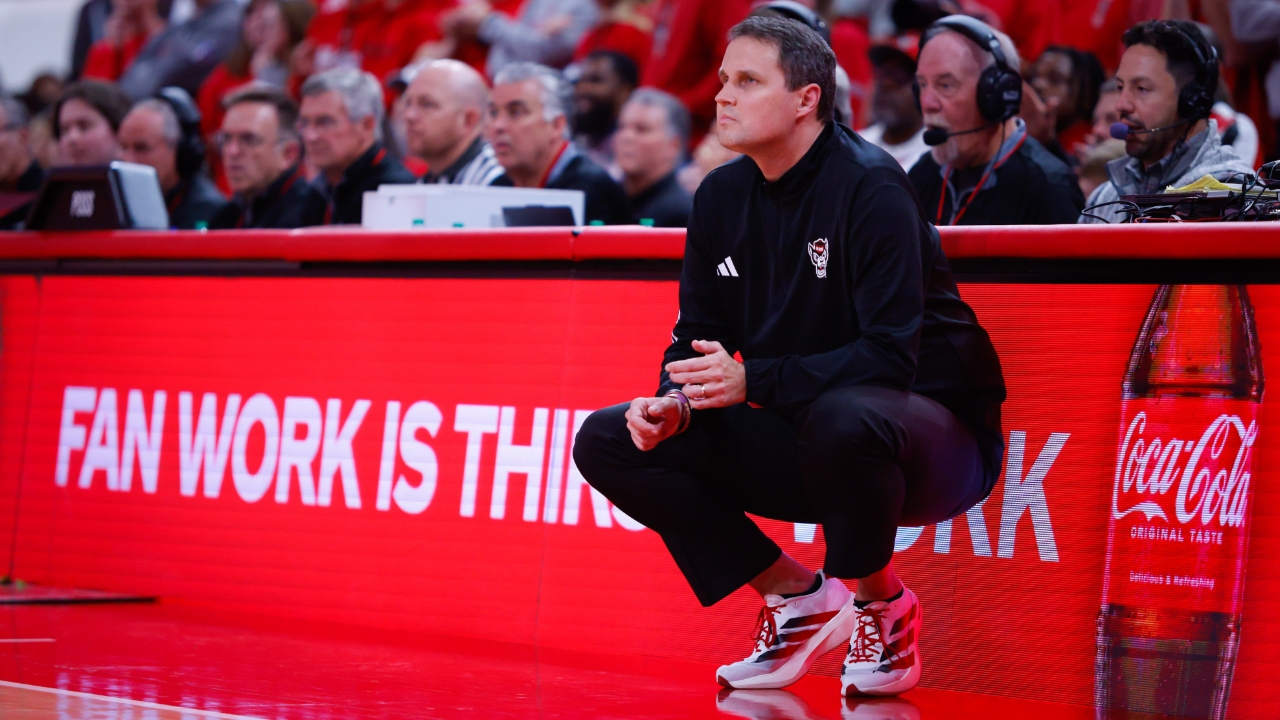
NC State head coach Will Wade met with Wolfpack Sports Network for his weekly radio show to discuss the Boston College win, Darrion Williams, and much more!
Hey, 11-5. Road win at Boston College. Maybe against the league's best defense. Statistically, it was the league's best perimeter defense. That was the best three-point defense. You shot great here at Boston College. Break down the Boston College eagle win for us here before we get into the teeth of the rest of the season. It's been a while since we've talked.
Yeah, I mean, the main thing is we moved the ball better. It was our best offensive performance of the year, statistically speaking. Better than even Greensboro and some of the games we scored 100 points.
So it was good. The main thing is our biggest issue has been all year, and it happened in the Virginia game. It's happened in a lot of our losses, once we lose momentum, we can't gain it back. And so we let a 4-0 run turn into a 14-0 run. We let an 8-0 run turn into 19-0, or 19-2 or something. So we have a very hard time turning the tide within the games.
So the best part about Boston College is the longest run Boston College went on was 5-0. So we were able to keep the margins where we needed them to be for us to basically have a working margin to win. Now, the shooting and all that stuff is certainly nice, but it was more about us being able to limit their runs and not put ourselves in those deep holes.
If you look at all of them, I mean, Seton Hall had a huge run to start the second half on us. Auburn had two huge runs. Virginia, I don't know when we can talk about that. I'm sure you want to.
We could. It's kind of what we're here for. We could talk about it.
But I'm saying, I mean, everybody knows they had a massive run the first half. Texas had a massive run in both halves. And so, that's kind of been the common denominator is we haven't been able to dig ourselves out those holes quick enough. So I thought that was good progress at Boston College. We've tried to get our guys to just kind of stop, reset, move on to the next play. And we're not where we need to be with that, but we're better than we were. We just got to pause for a second.
Mentally, and emotionally reset, take a deep breath, and then move on. We can't do anything. It was the best play or the worst play of your life. It doesn't matter. We can't do anything about what happened. We've got to move on to what's going on right now. And we have a very difficult time individually and as a group being able to move forward. So I don't know. That's a word salad on a bunch of stuff at Boston College.
But the main thing is we didn't allow the big runs. I mean, yeah, the offense was better. But we also, we got Darrion and Q running parallel to each other one of the few times all year.
One of them had a 31% usage rate. One of them had a 30% usage rate. That's exactly how it needs to be instead of, 38% and 22%. So we were able to get those two running parallel, which helped the rest of the offense move.
Tell me more about usage rate and what that computation entails. When you say usage, I've heard you say you like it.
The most simplistic version is the amount of times, the percentage of times that the ball ends in their hands to make a decision at the end of the play. Shoot, pass, whatever you want to do. That's the most—I mean, there's more to it than that. So what if a player was like a proverbial— So let's put it this way. Like I had to sit down with Q before the game. Like in the Virginia game? Like in the last three games before Boston College. All right, who's the best player in the NBA right now?
Jokic, Giannis, LeBron. What, who do you want—
You don't pay attention to the NBA.
A little bit, I do.
Who won the World Championship last year?
The Thunders, Shai, SGA.
So SGA. Shai Gilgeous-Alexander. So he has the ball for the Thunder, the best team in the NBA. He has the ball 38% of the time for the Thunder. In our last three games, Q had the ball over 40% of the time. I said, so what in the–
What in the world are you doing? What in the world are you doing? I was a little more colorful than that. Sure. But if the best player in the world has the ball, like, what are you doing? Yeah, it's too much. Get the ball out of your hands. There's other people.
So how did he respond to that? I mean, the SGA example, I would think that that would resonate. Right. Or how do players in general— He had 10 assists.
Yeah, he played great. Yeah, he played great. He had 10 assists, and I explained to him, Q, in the games that you shoot 10 or more shots, we're 1 and 4. Right. What else do you want me to tell you? Well, I can get to the rim. Well, no joke, you can get to the rim. But that's what they want you to do.
Right. Interesting.
Because when he's shooting, that means Paul's not shooting. That means Matt's not being efficient. That means other guys— So we had to recalibrate that part of it, and the guy who took the brunt of that is Darrion, who has to have the ball.
And when he has the ball over 40 minutes, look, he's going to take some crazy shots. He's going to miss some layups. He's going to shoot that little fadeaway I don't like. He's going to do all that stuff. But over 40 minutes, when you give him the ball, you win. Over 40 minutes, that stuff contributes to winning.
And so you have to get him the ball over 40 minutes. So the biggest difference was we had Darrion at 31 percent, Q at 30 percent. And so then the offense just all of a sudden looks better.
Well, no joke. We've got the two guys who can create rotation and do that. And what happens is they just load up on Q when he's got the ball for 45 percent of the game.
I mean, in the Virginia game, Q had the ball for over six minutes himself. Darrion had it for two minutes. That can't happen. If you time the actual time they had the ball— I mean, I told Q we're going to have to buy a new air pump, pump the ball back up on the dribbling.
And so that was the main thing that we need to get fixed.
And is that why Darrion was the point guard?
Yeah, that's why he was the backup point guard. Now, something that's on Darrion. I love Darrion, obviously. You have any questions on him?
We could talk all about him.
But I love Darrion. He's not the most aggressive person by nature. We had to change some of the offense. I told my staff, we don't get any extra points for looking cute. Let's just get the ball to Darrion, get the ball to Q, screen the worst defender on him, and then get the hell out of the way and play.
We don't get any extra points for swinging and looking nice and this guy doing this and setting this. Let's just get straight to the point. We did that much more at Boston College. And so by having Darrion play point guard, he played a point guard when Q wasn't in, and I'm going to keep doing that even when Tre gets back. It forces him to have the ball. It forces him to have the ball.
And so for 12 to 14 minutes a game, he's going to have it there, and then you have Q who's more in tune with what needs to happen, then that helps. It's not that Q and Darrion need the ball to score. I want to be clear about that. It's because they're a two-leader and assist too. And so they're the guys, and they're also the guys who can put the defense in rotation. We don't have anybody else on our team that puts the defense in rotation.
Those two guys put the defense in rotation, and both can do it without an on-ball screen too. And so those are the guys that make the defense move better than anybody on our team. That's why they've got to have the ball, and when they have the ball, it's been proven that they're going to make the right play.
Well, what Darrion has been proven, Q most of the time, he's going to make the right play. But the numbers are pretty stark in that, and so we ran a much simpler and much better offense in the Boston College game because of that.
Relatedly now, Darrion's 11th in the league in assist to turnover. Q's like 15th, I think. Those are your top two assist to turnover ratio guys. It's one thing to get assist. It's another thing to do it efficiently. I know that you love that number and what the data reflects. You had one first half turnover against Boston College. You had four total for the game, which is elite.
A couple of them were corrected. One of them was a one-handed catch, which I hate. In the second half in front of our bench, one-handed catch, gave him the ball. Another one was a charge where I don't know what the world was going on. The ball was above his head. He just plows over the guy. So you have two. I told Q, I watched film with him today. I told Q, I said, I've been coaching 20 years. I've been a head coach for 12 years. I have never seen this.
How happy were you with that specific to who was running point and how you were operating the offense? Because you said it was your best offensive game of the year.
It was our best numeric game by far of the year. Sometimes you score more and stuff because the possession battle and that sort of thing. Just points per possession and all that, we were the best we've been. Slightly better than Greensboro and North Carolina Central. And the opponents, they had their best defense in the ACC coming into the game. That accounts for some of it as well.
Look, basketball is pretty simple. If you shoot it four, you turn it over, you're going to be pretty good most of the time. In the most simplistic form, you just got to put it on the basket. If you turn it over, the other team's going to score or they're getting a high percentage. Look, if you shoot it, one, you got a chance to make it. Two, you got a chance to get fouled.
Three, you got a chance for an offensive rebound. So you got three pretty good options if you can just get a shot on the basket. Look, Florida State, I know we'll probably talk about them.
I don't know where you got that in all your notes. I got a headache looking at all this stuff you got up here. Wherever Florida State is and all this stuff, Florida State shoots a ton of threes. I'm sure you're going to ask me about all their threes. Look, they're going to shoot a ton of threes.
Them making or missing the threes is what it is, but they're going to shoot a ton of them. In their wins, they average 26 points off the opponent's turnovers. In their losses, they average 10. The number one key to Florida State is don't go in there and turn the ball over. I mean, their losses are getting 10 points off turnovers. I mean, look, they hit 14 threes on you. All right, that's embarrassing. That's not great. That's 42 points.
You're not winning a game with 42 points. You've still got to get other points, and that's points off turnovers. That's free threes, all that sort of stuff. So I don't want to hit 14 threes. Let me be clear about that. Yeah, it's not desirable either. Okay, noted. But my point is we've got to value the ball. Four turnovers was great, but we've got to keep our turnovers way down in Tallahassee or it's going to be a problem.
On Florida State and Luke Loucks…
He’s done a very good job. He has truly instilled his style of play in the team. Defensively, they still switch quite a bit—one through four and one through five—but their offensive system is very 'NBA-esque.' They move the ball from side to side with great flow.
Currently, they are second in the country in three-pointers attempted per game; about 54% of their shots are threes, which is the second-highest percentage in the nation. They also rank seventh in pace. While most teams have a specific 'big' take the ball out after a basket, they just have the closest person grab it and go. There are times when the opposing team scores, and they respond with a bucket of their own in just three seconds. They play at an incredibly fast pace, reflecting a heavy NBA influence.
He’s done an excellent job with this group, really instilling his vision. They played very well against Duke in their last outing. They’ve been off all week, but in that Duke game, they led for quite a while and performed well.
It’s going to be a big challenge. Anytime you go on the road, you have to level up. I told our guys—and this is no disrespect to our previous opponents—but moving from Wake Forest to Virginia was a big step up, and we didn't learn enough from it. The same mistakes we made against Wake that we got away with, we couldn't get away with against Virginia, and it showed.
We started with Boston College on the road, but Florida State is a step up in class. If we don’t learn the lessons from the BC game, it’s going to be tough. Defensively, we were poor in that game. Our switches are supposed to be 'heels on the three-point line,' but we were inside the line, giving up ground. They were just ripping through us, driving and spinning, leading to fouls and easy layups. If we switch below the three-point line against Florida State the way we did at Boston College, they’ll score 110 points on us. We have to apply those lessons at a higher level.
Their guard, Robert McRay V, is one of the best ISO players in the ACC—third in the league in ISO scoring and, I believe, second in assists. They do a great job of picking at matchups. I told our guys, 'It’s going to be like Where’s Waldo?' They are going to find the weak link defensively, put you on an island, and attack.
In the Duke game, they ISOed for about ten minutes in the second half. They got McRae switched onto exactly who they wanted, and he just drove around him like the guy was standing still. That’s how they stayed in the game. They’re going to do the same thing to us. Their strategy is simple: don't turn it over, get your best player matched up against the opponent's worst defender, and let talent take over. That’s a pretty good strategy
Nobody can deny that Robert McCray is one of a handful of highly productive transfers here for Florida State. As you mentioned, 54% of their shots come from behind the arc. That averages out to about 36 three-pointers per game. They actually took 30 against Duke, which was six below their season average.
It is likely the polar opposite of the Boston College matchup. BC is one of the slowest-paced, worst-shooting teams in the league, whereas Florida State is arguably the fastest and most active three-point shooting team in the conference. It’s an interesting juxtaposition to have to play those two styles back-to-back this week.
Yeah, that’s just life in the conference. Everyone plays differently, and everyone tries to impose their style and their will on you. As I said, there are certainly things we can take from the Boston College game—specifically in terms of preventing those big runs—that we can apply to Florida State.
However, it will be a completely different game with a different pace and a totally different vibe. The crowd will be much better; at Boston College, it felt like a COVID-era game in terms of the atmosphere.
What is your take on a lineup featuring? Musa, Ven-Allen Lubin, Darrion Williams, Quadir Copeland, and Paul McNeil, which is a big line-up.
It's a great lineup. It's a big lineup.
Do the strengths outweigh the weaknesses?
Yes, it's a good lineup. We should play it more. Thanks, Gary. That's a great question. Maybe hire Gary in our analytics.
That's a good lineup: Q, Paul, Darrion, Musa, and Ven. Then you’ve got to move Mo to the four; he’s effective there. The funny thing is we need to let him shoot some threes. Statistically, he shoots better from deep than about three guys we have out there shooting them right now.
Now, I don't want him shooting a bunch. I told him, 'You shoot one and it goes in, you get another. You shoot one and it doesn't go in, don't think about it—just forget about it, go into the uphill dribble handoff, and stay out.'
It’s like a coach's challenge.
Yeah, kind of like that, but don't get me started on those! Officials are like, 'We’ll just challenge it.' Well, just get it right the first time! It’s like the guy in the Wake Forest game, not it’s not. He was like, well good you won the chance I was like, yeah, I won the challenge, but I only get one more the rest of the game, right? I did that with ten minutes to go in the first half like won't you get that call, right?
And so I don't have to but like Miami last night won both their challenges Miami won both of them last night and they were out with a minute left in a tight game. Like if you keep winning the challenges you should keep getting them. Like why is it only two is not the officials would the officials would agree with that? I think most of them but why do you stop it to like if you keep winning them you should get why should you be? Punished for getting it, right, right.
Yeah, that doesn't make sense. That's a good question. Well, and they may it's brand new, maybe they will evolve it?
Maybe they should adjust that. I also think—and you're probably not going to like this—that they should do away with the 'use it or lose it' timeout in the first half. You should get four timeouts for the entire game, and if you don't use one in the first half, it carries over.
Because of the challenges, you really only have three timeouts to use. If you challenge in the first half and lose, you lose the timeout. You should have four for the entire game. Now, the reason they do it this way is so they can sell sponsorships and get one more media slot in the first half, but they can figure that stuff out.
If you're going to have challenges, you should get four timeouts for the game. You shouldn't have to use one in the first half—and if you keep winning your challenges, why should you be punished? It just makes sense.
How do you feel about the transfer portal?
That’s a pretty broad question. I mean, I like it; I don’t see anything wrong with it. I'm not going anywhere, and I’m going to be active in that bad boy again this spring. You can’t put the toothpaste back in the tube now—it’s out.
It’s fine, but we learned some lessons this year. We weren't perfect in what we did in the portal. We did a good job, but we didn't do a great job. I actually met with a couple of our folks today for about 30 minutes to adjust our process and ensure we don’t make the same mistakes. I don’t want to get into specifics because I’d have to talk about specific players, but we understand where we overcorrected. We paid too much attention to certain things that caused us to pass on better players who maybe didn't 'fit' certain criteria. We’ve course-corrected, and we’ll be ready to roll when the portal opens up in the spring.
The portal is a double-edged sword—it gives and it takes away—but overall, it's a good thing.
The bigger issue now is all these international kids coming over. They’re taking spots that, in theory, would go to the kids entering the portal. We’re going to get us some international 'world travelers' too. Musa is a good player and we’re excited to have him, but with the way things are opening up, there are 23 and 24-year-old pros overseas who are eligible for a year or two. Look at Virginia’s big guys—both Thijs De Ridder and Johann Grunloh, for instance.
We have a whole list of guys over there who potentially have a year or two of eligibility, so we’ve been combing through film on all of them.
You’re smiling ear-to-ear.
I’m ready to go. I wish that thing opened tomorrow! You can’t trade the players we have now, and we’re ready to roll with them, but we had to get twelve guys together pretty quickly. Now, we’ve got a much better handle on things and a better grip on the international market.
The international market is getting picked dry a little bit because a lot of the good ones came over this year, but with the way the eligibility rules are now, there are plenty of kids over there who may not have three or four years left, but they have one or two.
How would you describe our style of play?
We’re still evolving. The way I look at style of play is that we play how we need to play to win, and that changes from game to game. You certainly have basics—valuing the ball, not turning it over, being solid defensively—but a lot of the specifics change based on the opponent.
One thing that’s been challenging with this team is that we don’t have much carryover. You almost have to wipe the board clean and start over every game. There’s no guarantee that because a guy played well one night, he’ll have that confidence or 'juice' the next; with this group, it’s often the opposite. That’s been a challenge for me.
That lack of consistency contributes to things like our offensive rebounding. Despite some of the great stats you point out, we are the second-worst in the ACC in offensive rebounding, which is pathetic. We’ve always been good at that, but right now, we just aren't.
We rebounded well at Boston College because we took better shots and knew where they were coming from. We work on it every day, but we just aren't very good at it yet. It’s disheartening, but if we aren’t going to offensive rebound, we better take great shots and make the first ones.
How is your family adjusting to living in Raleigh?
I love living in Raleigh; my family loves it. My daughter is at gymnastics in Cary right now, so she’s out there doing her thing. It’s been great.
What's the biggest challenge you faced with this team with the talents and attitudes on the roster?
There aren’t really any attitude problems. Like I said, we have a new team every day, so we haven’t been able to have a lot of carryover; everything just resets daily.
If you could change something about this year's team, what would it be?
I'd want them to have a little bit more aggression.
Okay, you've got some pictures there—flowers and a teddy bear—on the back of that.
That's about how our team is, flowers and a teddy bear.
Will, what is the biggest thing you have learned so far this season?
One thing I’ve learned is that I usually let our guys play through the other team's runs, but I’ve used more timeouts in the first half with this team than in my entire career combined. I haven't called five timeouts in the first half to stop runs in my whole career, but I called two in the Virginia game and two against Texas.
We just haven’t been able to self-correct. It’s been a learning experience for me; we need to recruit a go-to guy who can stop a run himself without me calling a timeout.