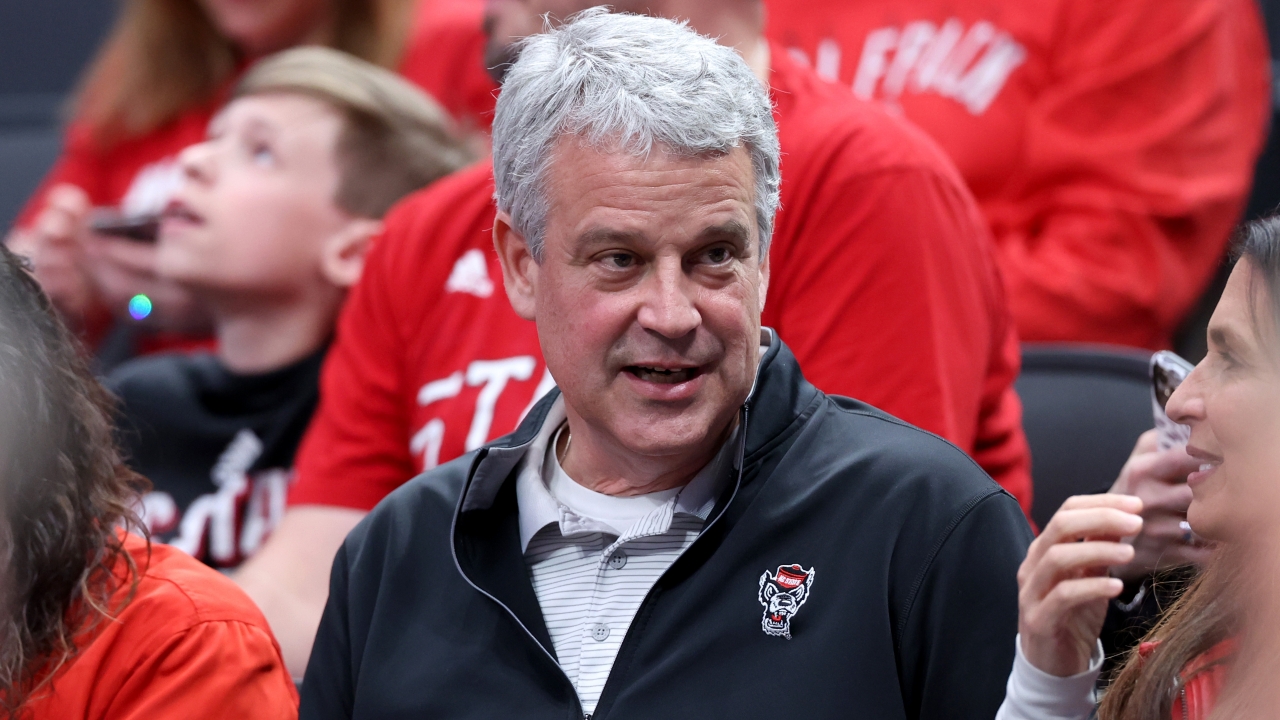
NC State AD Boo Corrigan was on Wolfpack Weekly last night and discussed a variety of topics. Here is a look at what all Corrigan had to say!
Opening and State of College Athletics
Matt Chazanow (MC): Special edition of the show this week — it’s Wolfpack Weekly alongside Tony Haynes. Matt Chazanow with you, and we are delighted to put our Director of Athletics, Boo Corrigan, to work.
Boo Corrigan (BC): It’s good to have you guys here. I look forward to catching up on a number of things.
To the best of your ability, since the start of football until now, what’s the state of the union in college athletics? Big picture — how much has changed? I know the phrase “keep your knees bent” always comes to mind.
Yeah, it does. And the more things change, the more it comes back to this: we’re providing an unbelievable opportunity to get an education. We’re providing an unbelievable opportunity to better yourself through sport, academics, and socially — in who we are, what we do, and what we’re proud of.
So, in a lot of ways, it’s made me refocus on our core mission: educating young people. We want to win championships — make no mistake about that. We want to win every time we compete. We want to provide a great environment for our fans. We want to make sure we’re there with a revenue share. We want to do all of those things. And while some things have changed in the last three months, a lot of it is still the same — just tweaks in how it all works.
There’s been another significant — maybe not “magnificent,” but significant — change since the House settlement and the move toward revenue sharing. That’s where the tweaks are coming. But, long story short, we’re still in the education business — and that’s the business we all got into and want to stay in.
Now the question becomes: how do we continue to be competitive, how do we continue to provide great environments, and how do we do that while never losing sight of what’s most important?
Family Legacy and the Evolution of Collegiate Athletics
MC: Your dad, Gene Corrigan, was a giant in college athletics. Do you ever think about what he would have thought of the current environment?
I do. He adapted to everything in his career. This was a guy who, when he started, got hired as a lacrosse coach, also became the soccer coach — and he’d never seen a soccer game. He was an assistant basketball coach, then just lacrosse and soccer, and also the sports information director. We have seven SID staffers now, so it’s changed a lot.
What I think about — and not to be overly provocative — is this: if he or someone like Roy Kramer were still in a leadership role five or seven years ago, would we be where we are today? We had some true giants in college athletics who all left around the same time. Would things have played out differently if they’d stayed? That thought has crossed my mind more over the last few months than ever before.
But I take comfort in knowing he mentored a lot of people throughout his career.
Background and Core Values
MC: Your father was the AD at Notre Dame. You were an undergrad there and worked there, and you’ve also worked at Navy and Army. How much did those places shape how you approach college athletics and your vision for NC State?
A lot. The value of higher education we talked about earlier — nothing impacted our family more than my father’s path. My brother Tim is a Senior Vice President at ESPN, my brother Kevin has been the lacrosse coach at Notre Dame for 35 years. It all speaks to the value of education and connection.
You learn something at every stop. Working at Notre Dame from ’04 to ’08 with Kevin White taught me a lot. Going to Duke showed me again the value of education and excellence. Then returning to college athletics at the Naval Academy — that was special.
My wife, Kristen, grew up on a college campus; her dad was the AD at Villanova. We decided that wherever we went, we wanted to be aspirational for our kids. That’s carried through from Navy to Notre Dame to Duke to West Point to NC State. Our youngest son, Brian, is now a junior here.
Being around those institutions and leaders helped me understand the bigger mission of what we do. Every day on a college campus is better than no days on a college campus. Student-athletes take a harder path — being a student and an athlete is demanding — but it prepares them for life. They learn teamwork, discipline, and how to rely on others.
Military Academies and the Army–Navy Game
MC: I want to ask about West Point, because players there can’t accept NIL, right?
Right. Being at West Point is a different kind of decision. Most cadets don’t go there thinking, “I’m going to be in the Army.” They go thinking, “I’m going to be a student-athlete.” Then they realize, “Wow, this is a great team — the U.S. Army.” I don’t think they could ever really get into an NIL model. The decision they’re making from the start is just fundamentally different.
MC: Take me through the Army–Navy week. For someone who’s never been, what’s that experience like?
The whole thing is remarkable. In a lot of ways, it feels like stepping back into the 1960s. There’s a pep rally the night before, and you cheer as the buses leave for Philly or Baltimore or wherever the game is. Then there’s the gala Friday night — an incredible event.
Nothing changed our family more than being at West Point. It shaped who we are and what we believe. You look over and there’s Joe Bellino, Roger Staubach, admirals, generals — and I’m sitting at a table with Pete Dawkins and others.
Then the next day you watch the march-on. It’s an American treasure. Truly. And I can tell you one thing: winning is a lot better than losing. We won three in a row on our way out, and seeing grown men and women cry, seeing generals get emotional — it’s incredibly powerful.
The ACC and the Role of the Commissioner
Tony Haynes (TH): You and your family have deep roots in the ACC. Has every commissioner faced challenges trying to keep everyone happy and moving in the same direction?
Definitely. When my dad was commissioner, adding Florida State was a big deal, and getting everyone aligned on that took work. Then John Swofford came in and continued expansion.
All three commissioners — Dad, Swofford, and Jim Phillips — have always looked at the bigger picture. That’s crucial. It’s easy to lose sight of that. Jim, who I’ve known a long time and have great admiration for, really does focus on the larger enterprise of college athletics and solving the broader issues.
Working with the NC State Chancellor
MC: There’s a new chancellor at NC State, Kevin Howell. I think you were with him in a meeting earlier today. How has that relationship been?
He’s been great. He has a deep love for this university, having been student body president and a wrestler here. We started out as peers on the cabinet — clearly he’s had the better career path since becoming chancellor!
The magnitude of that job is hard to comprehend. In many ways, our roles are similar — both very public. That takes some getting used to, but he’s done a great job. I really appreciate our friendship first and our partnership second.
TH: I used to do interviews with Chancellor Woodson, and Kevin Howell would always be there wanting to talk football and basketball.
He loves it. He loves seeing students achieve. At the end of the day, sports are about two things: bringing people together and celebrating the university. And what better place to do that than Carter-Finley, in front of 57,000 for 25 or 26 straight games? He loves seeing the Pack come together and the pride everyone has in this place.
MC: The AD–chancellor relationship is more important than ever now, right?
Absolutely. People talk about alignment — and being aligned with your chancellor is enormous. Then aligning with your coaches, and the chancellor aligning with the board of trustees. If everyone’s in lockstep, communicating, and connecting on key issues, that alignment really matters.
Revenue Sharing and Program Management
MC: Revenue sharing began in July. What was your blueprint for preparing for that?
First, we had to decide if we were going to fully participate — get to that $20.5 million cap — and the answer was yes.
My job isn’t to pick the quarterback; that’s what coaches do. My job is to make sure they have the resources they need. We created a pool of funds for all sports and let coaches decide how to use it. If they wanted to go heavier on scholarships, they could. Coaches know their needs better than anyone, so giving them that flexibility made sense.
MC: Was the hardest part just getting it off the ground?
Yeah, that’s fair. We actually made our decisions the previous October, well ahead of July 1. I think we were earlier than most schools in finalizing our plan. That gave coaches clarity for recruiting and retention. That clarity — plus alignment with the chancellor and our finance office — was critical.
Federal Legislation and Managing Complexity
MC: There are several federal bills being discussed — the SCORE Act and the SAFE Act, for example. How do you see those impacting college athletics?
It’s important to be aware of everything happening. The SCORE Act is especially important because it could help level the playing field across states. Right now, different states have different rules, and that’s tough to manage.
We’ve supported the SCORE Act — the ACC even sent a conference-wide letter backing it. We’re also getting feedback from coaches about what’s most important to them as we navigate revenue sharing, NIL, and scholarship management under that $20.5 million cap.
I once asked Chancellor Woodson how he manages everything when the world feels chaotic. He said calmly, “You have the bandwidth to do it.” That stuck with me. It speaks to our staff — having great people who are subject-matter experts allows us to focus on the two or three most important priorities at any given time.
Program Success and Visibility
MC: Two years ago, football made a bowl game, both basketball teams went to the Final Four, and baseball reached the College World Series. What did that success mean for NC State as a whole?
It meant a lot. The university has continued to rise — in rankings, research, graduation rates, everything. Applications have increased, and that success across sports absolutely contributed. You can see it in licensing revenue, visibility, and recognition of our brand.
But beyond the national exposure, how great was it for our fans? Seeing us win the ACC Championship, traveling from Pittsburgh to Dallas to Phoenix, or following the women’s team from here to Portland to Cleveland — those are memories for life.
And I’ve reminded people: if your kids are 10 or younger, all they’ve ever known is championships.
Coach Will Wade
MC: What have your first impressions been of Coach Will Wade?
He is who we thought he was — intense, focused, and demanding. That’s Will being Will.
He pushes players hard in practice, but 15 seconds later he’s on the baseline dapping them up, talking through things. He has that rare balance — he can get on players and then immediately connect with them afterward. I always tell people, “Don’t take the volume, take the words.”
Juggling Responsibilities
MC: You deal with senators, NCAA policy, and everything in between. What’s your week like? How do you balance the macro and the micro?
You just do. Kristen and I love watching our teams play, and I enjoy that every day is different. You never know what’s going to walk through the door — though, to be honest, 80–90% of what does isn’t good news.
But I love it. We’ll grab dinner, then she’ll say, “Hey, women’s soccer plays — let’s go.” We enjoy being with our fans and donors and seeing all the positivity around our programs.
Let’s not forget — we’re 4–3, not 0–7. The bye week is coming at a good time. Cross country with Laurie Henes is rolling, volleyball’s playing well. Watching fans connect with student-athletes and with each other — that’s what makes this job special. I love what I do.
Coach Wes Moore
TH: Wes Moore wins. How does he do it?
In his own way. Wes is Wes. His ability to connect with players and recruits, to bring in transfers and help them fit into the NC State culture — it’s impressive.
We do things a little differently here because we keep the student-athlete journey at the forefront. That’s what matters most.